Riverside International Raceway
Pacific Coast Divisional Championship
Lotus Super 7
February 2, 1964
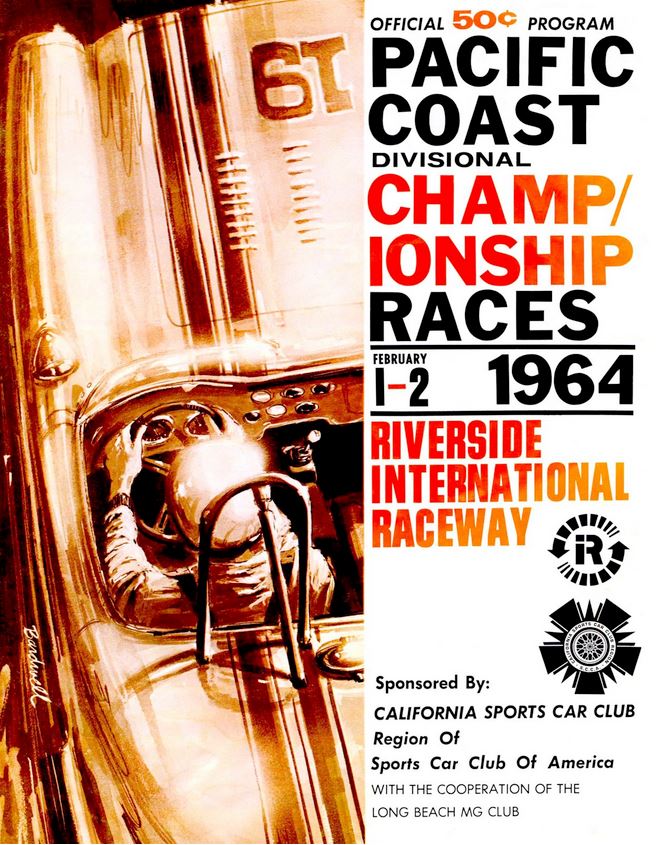
“Part way into the race, my engine overheated very badly because the pressure cap had been left loose. I didn’t finish and my engine was shot.”
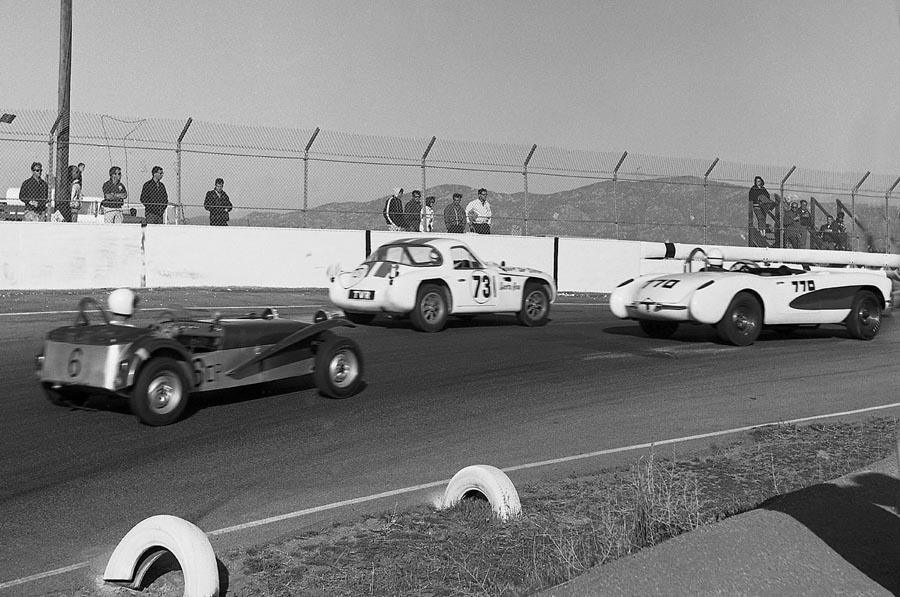
John Morton collection – Allen Kuhn photo (vintage-sportscar-photos.com)
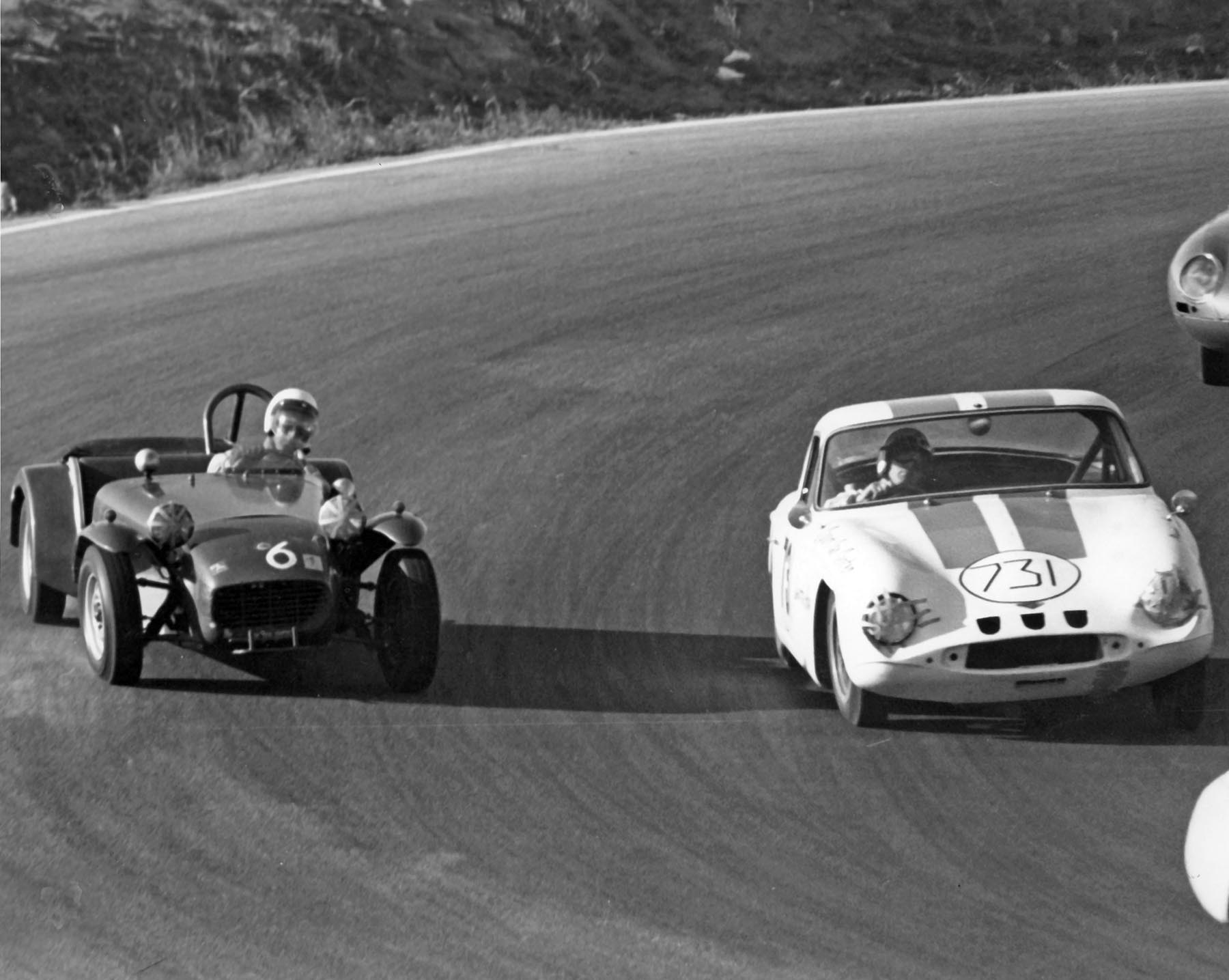
John Morton collection – Dave Friedman photo

12 Hours of Sebring
427 Cobra #CSX2196
March 31, 1964
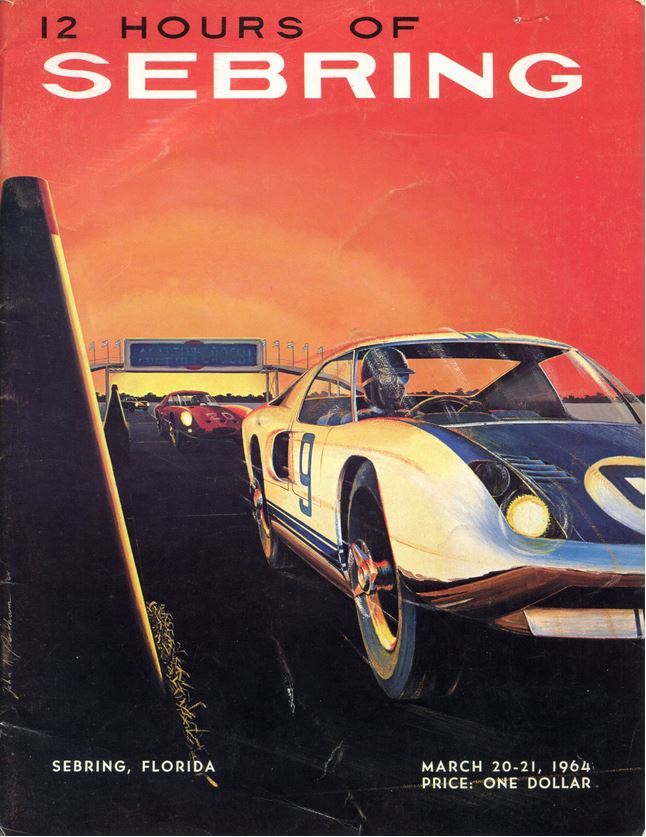
“Ken asked me: “Do you have an FIA license?” An FIA license is an internationally recognized racing license required for important races like Sebring, Le Mans, etc.
I answered, “No.”
He said, “Can you get one?”
“I don’t see how. All I have is an SCCA amateur logbook and I don’t have it here. Why?”
“Because we have five cars entered and only nine drivers. We might need you to drive the 427 with me.”
He took out a small pad of paper, scratched out a note, handed it to me and said, “Take this to race headquarters. See if they’ll give you a license.”
I read the note. It said, “John Morton is qualified to be issued an FIA license.” It was signed “Ken Miles.” I took the note to the Kennelworth Hotel where race headquarters was set up and handed the note to someone who looked to be an official. After a short time I was given an FIA license.”
Morton collection – Pete Lyons photo (petelyons.com)
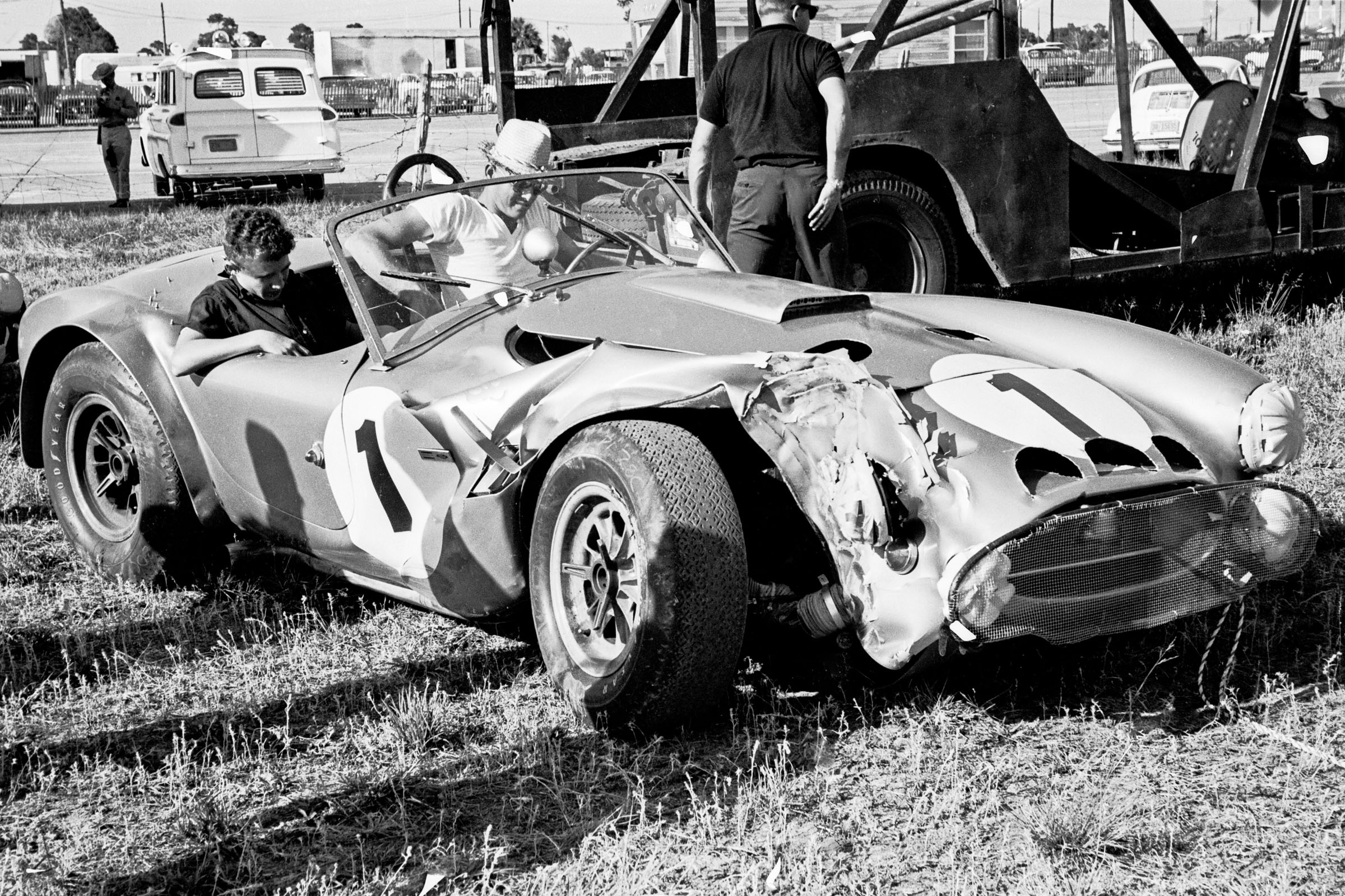
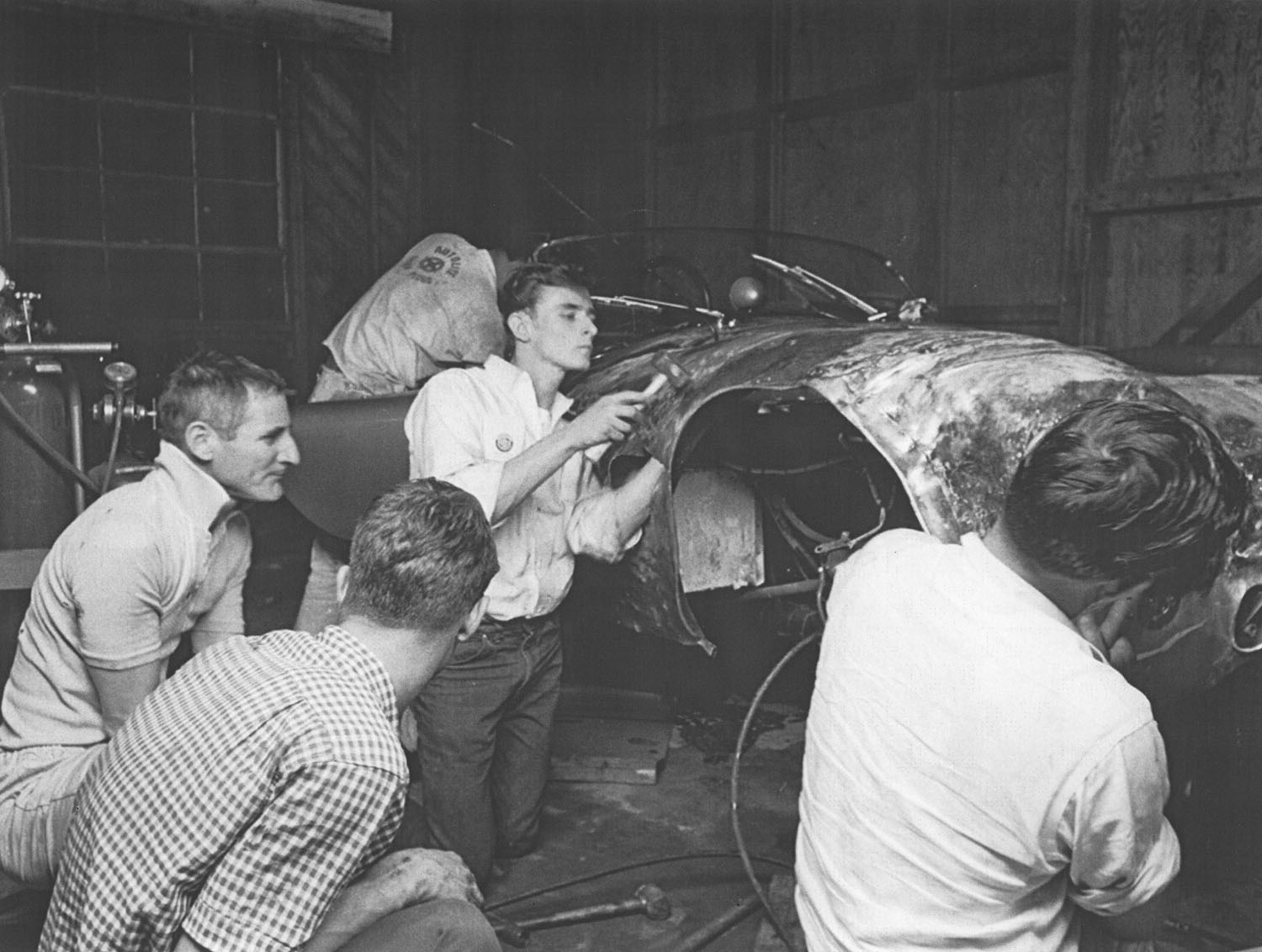
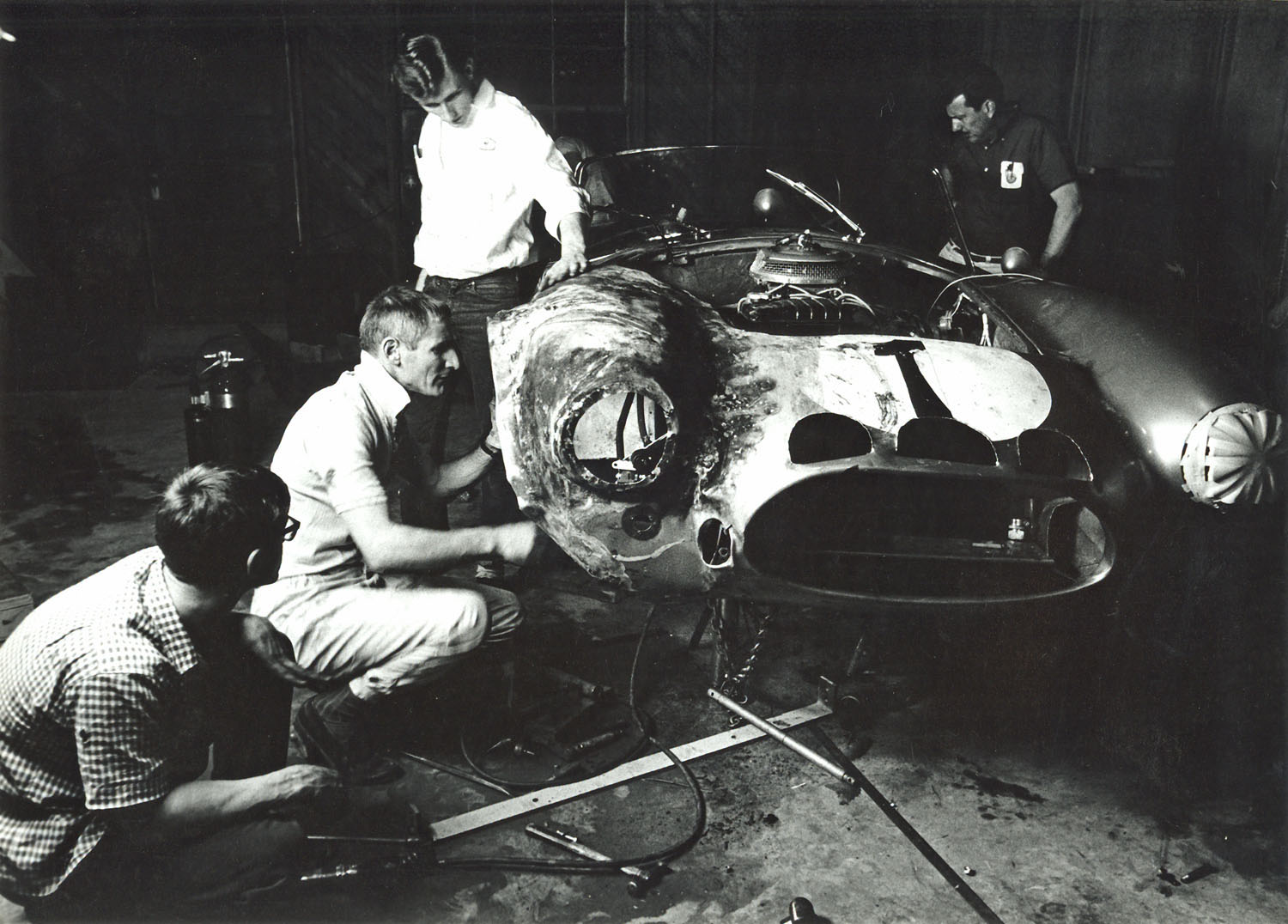
“… Ken hit a tree, the only tree it was possible to hit at Sebring. The damage was significant; my chance to drive had vanished for if the car could be repaired, which was doubtful since even the frame was bent, there would be no time for me to practice.”
Morton collection – Dave Friedman photo
Morton collection – Dave Friedman photo
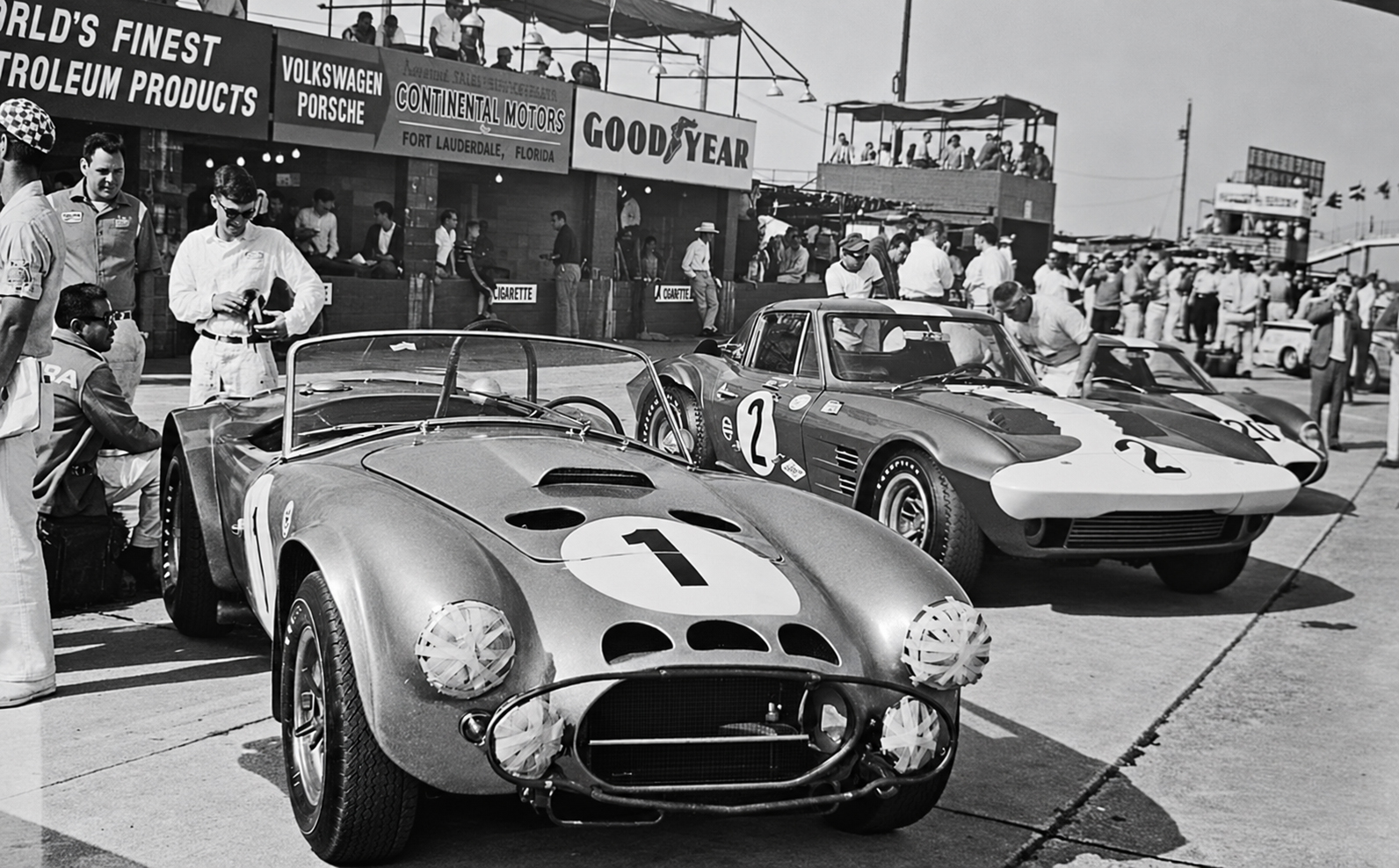
“I went to the house trailer that had been towed into the paddock area behind the pits. Carroll was sitting with some Ford people. He asked, ”John, do you know this track?” “Yes,” I answered. “I’ve been here several times.” I didn’t mention it was as a spectator.”
 Morton collection – Bernard Cahier photo
John with Ted Sutton and Garry Koike (kneeling)
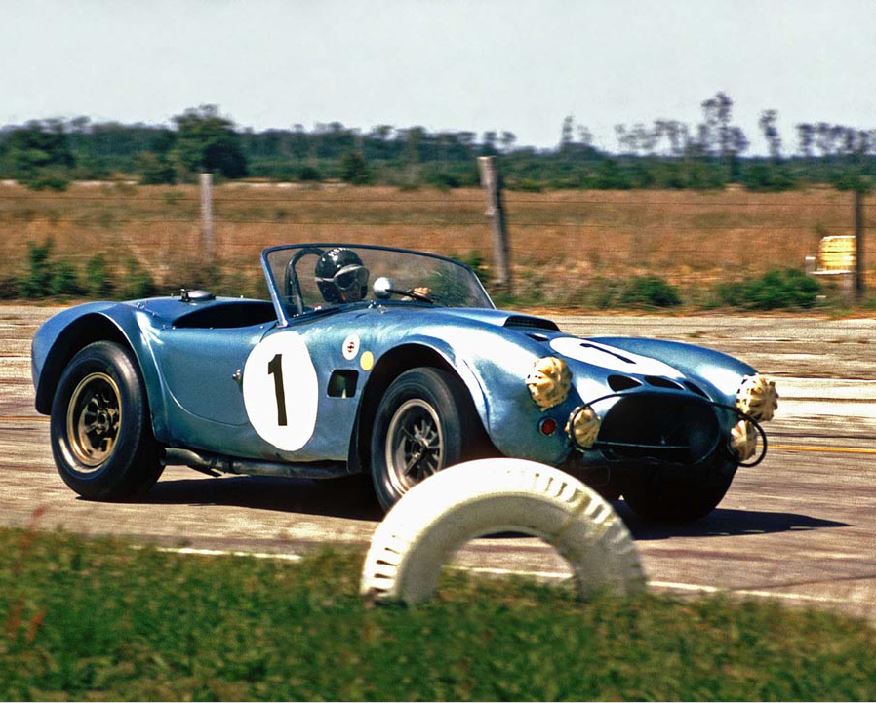
Morton collection – Ozzie Lyons photo (petelyons.com)
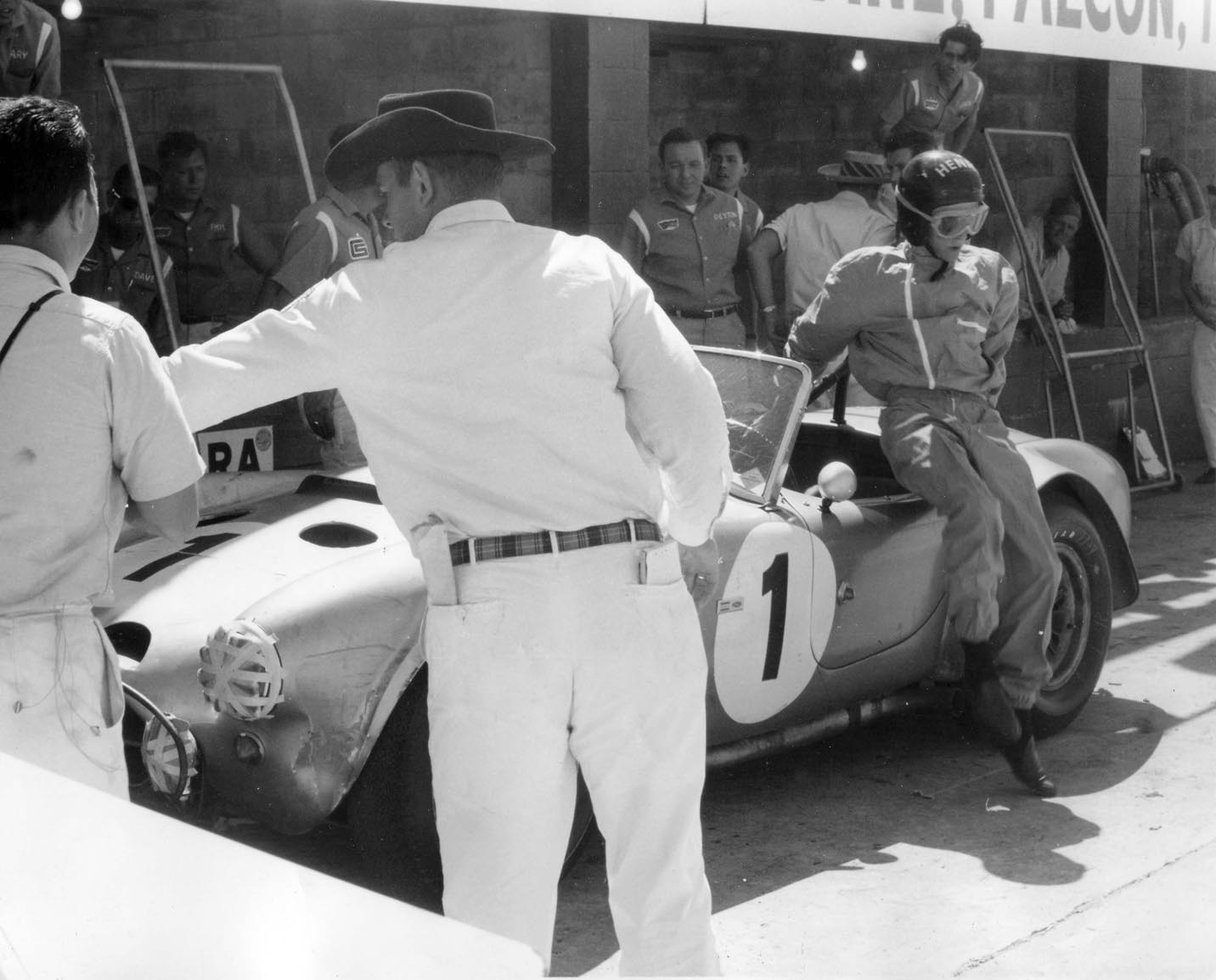
Morton collection – Dave Friedman photo
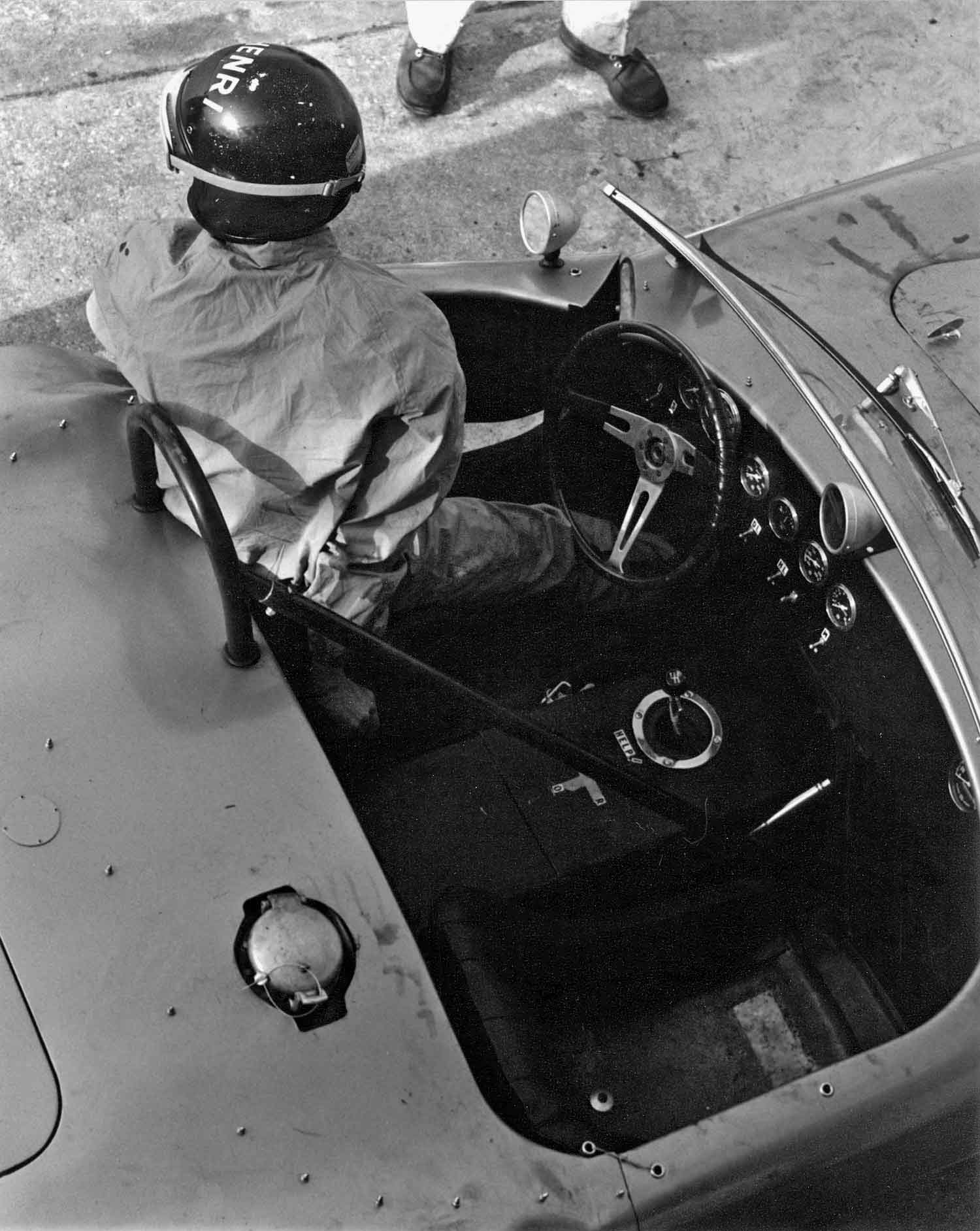
Morton collection – Dave Friedman photo
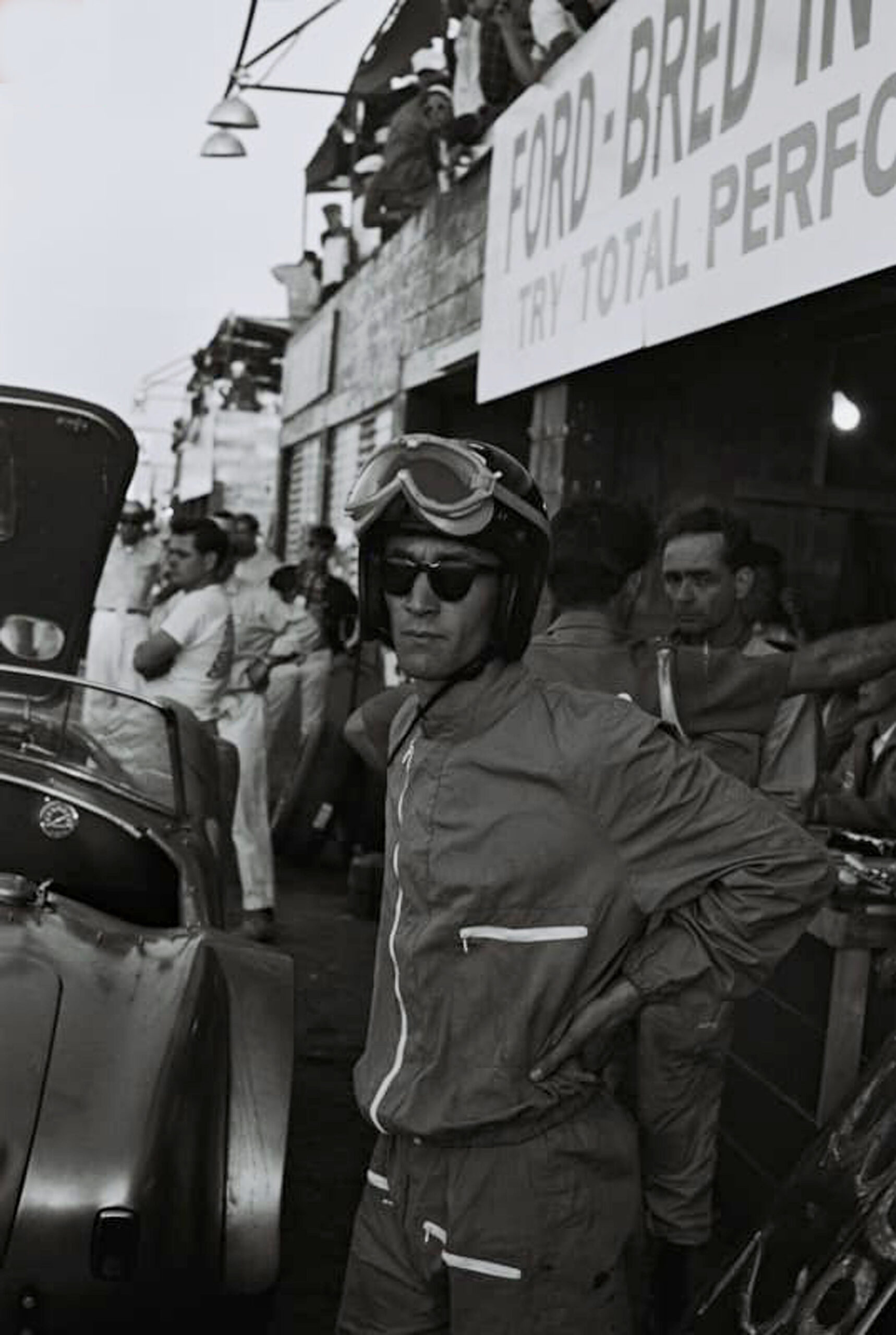
Morton collection – Dave Friedman photo
Morton collection
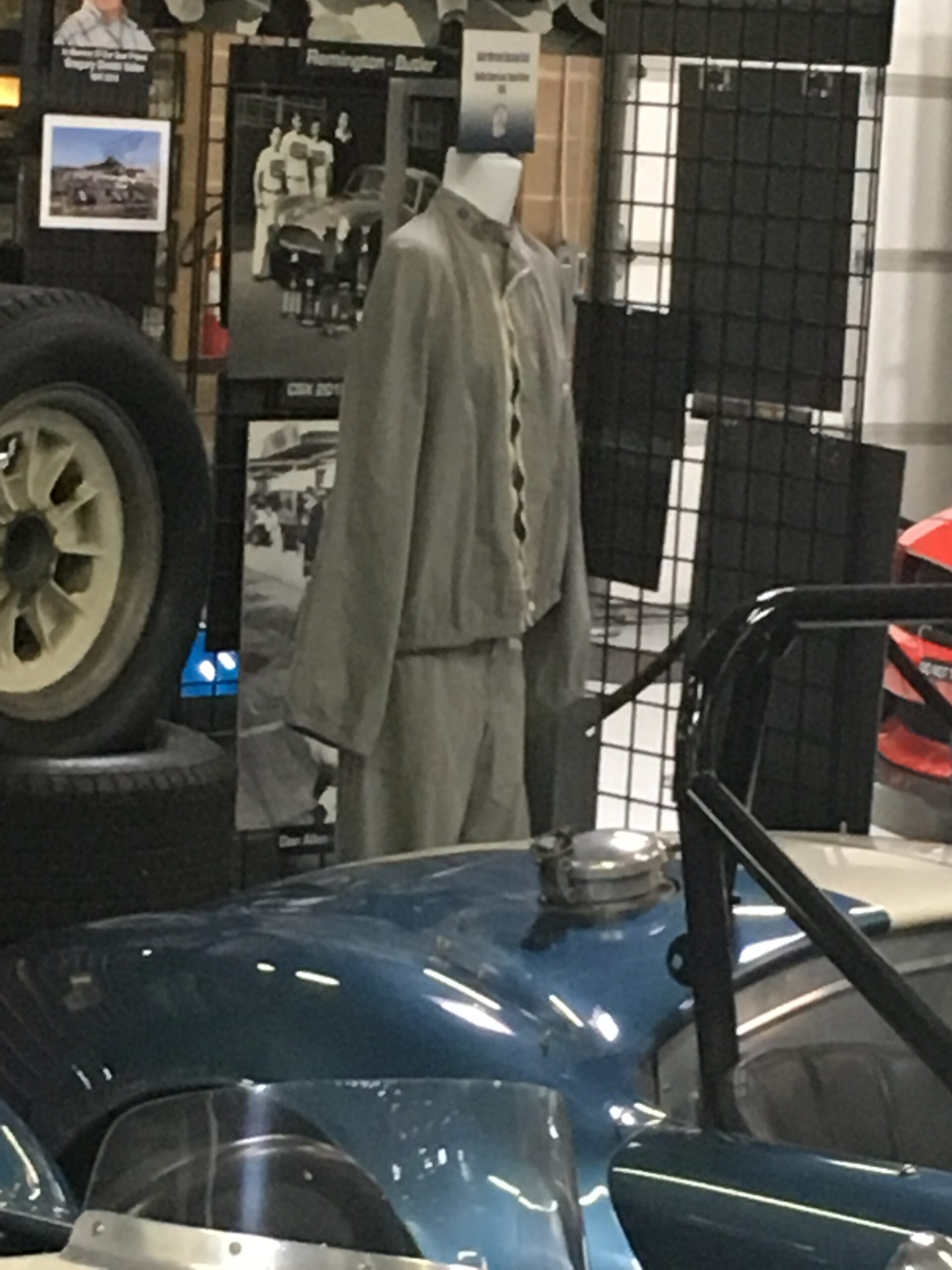
“I had no driving gear with me but I was able to borrow a helmet from a fellow who was running a preliminary motorcycle race on Friday before the Saturday 12-hour (Edd Brown). I bought a gray driving suit from a vendor at the track for fifteen dollars. I was ready.”
John’s driving suit from the 1964 Sebring race now resides in the Shelby American Collection in Boulder, Colorado.
Ken Miles, who had hidden the fact he had broken ribs from the crash, drove the first two hours. He was relieved by John, who drove through a series of stops to deal with clutch, fuel and brake problems until a blown engine eventually sidelined the 427 prototype.
SCCA Divisional Races
Tucson , Arizona
April 4, 1964
Shelby American was commissioned to race the first Tiger. Shelby mechanics Jim O’Leary and Ted Sutton prepared the car in early 1964 for the SCCA Divisional race in at Tucson, Arizona. Shelby team driver Lew Spencer was designated to race the new Tiger. John and Ted Sutton are shown with Lew Spencer in the photos below. The Tiger was painted in Shelby’s yellow and black Terlingua racing scheme.
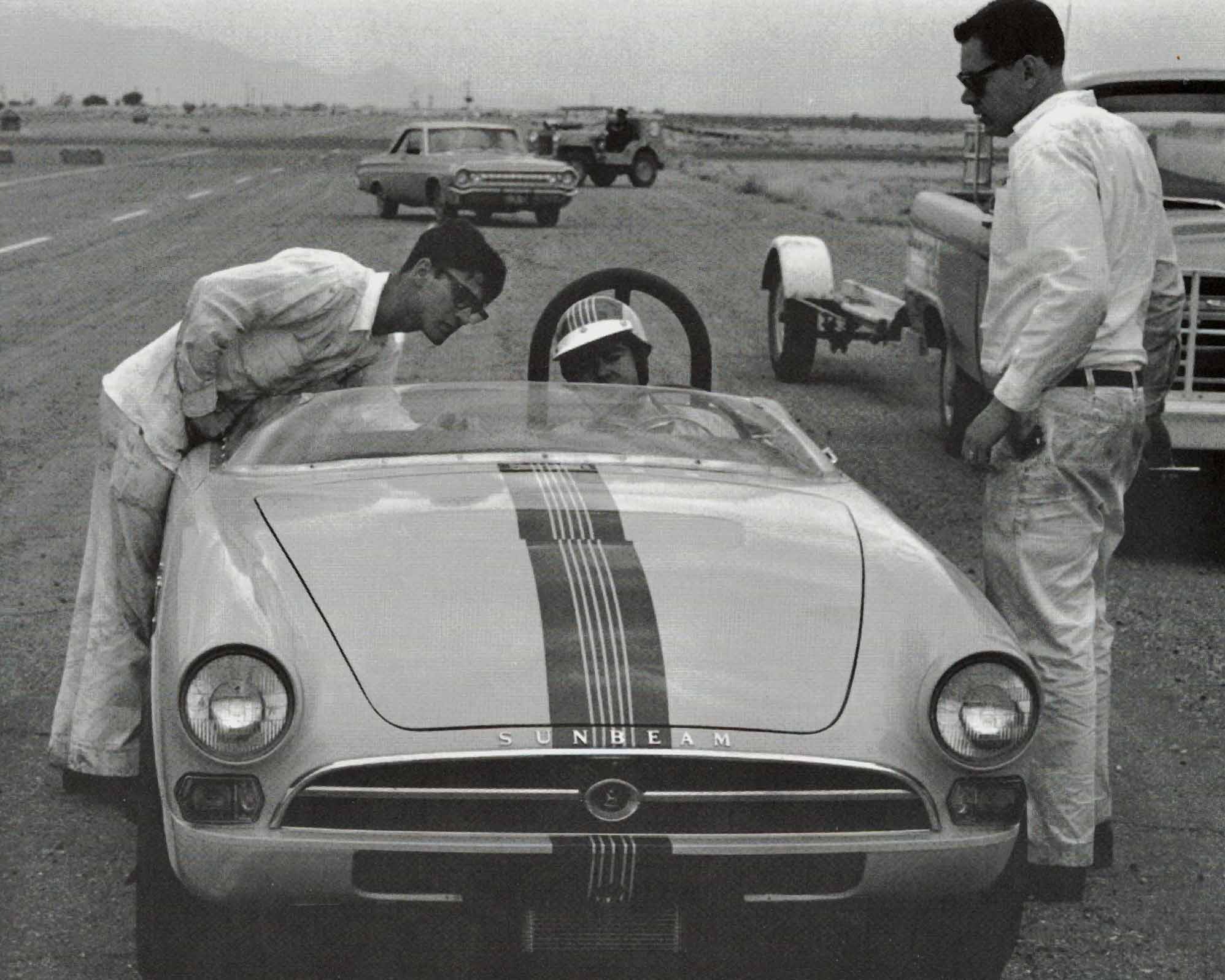
Morton collection – Dave Friedman photo
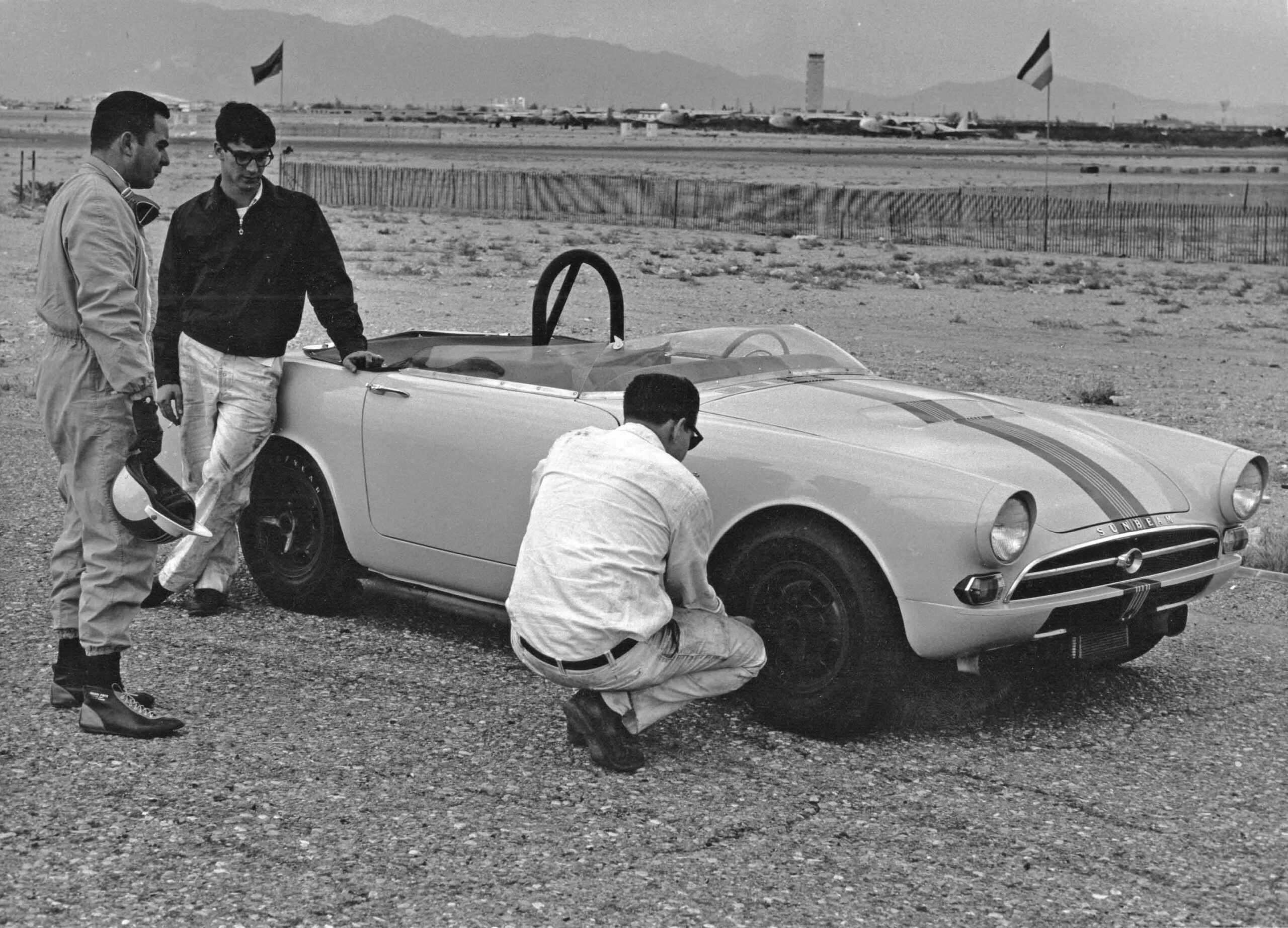
Morton collection – Dave Friedman photo
John with Lew Spencer and Peter Miles at Carroll Shelby’s facility in 2006.
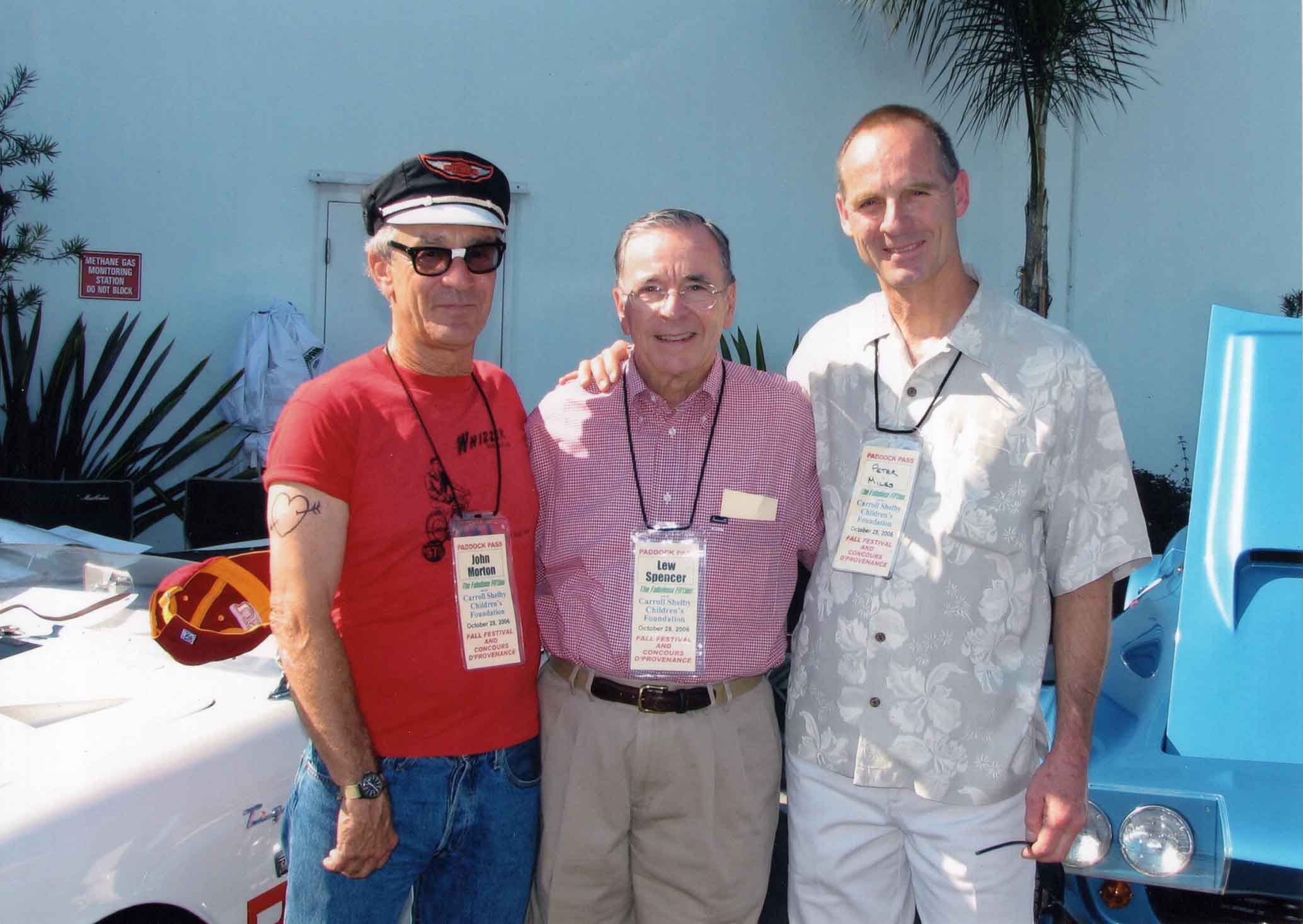
Morton collection
Laguna Seca Raceway
US Road Racing Championship
Lotus Super 7
May 3, 1964
1st in class
Morton collection – Dave Friedman photo
Morton collection – Dave Friedman photo
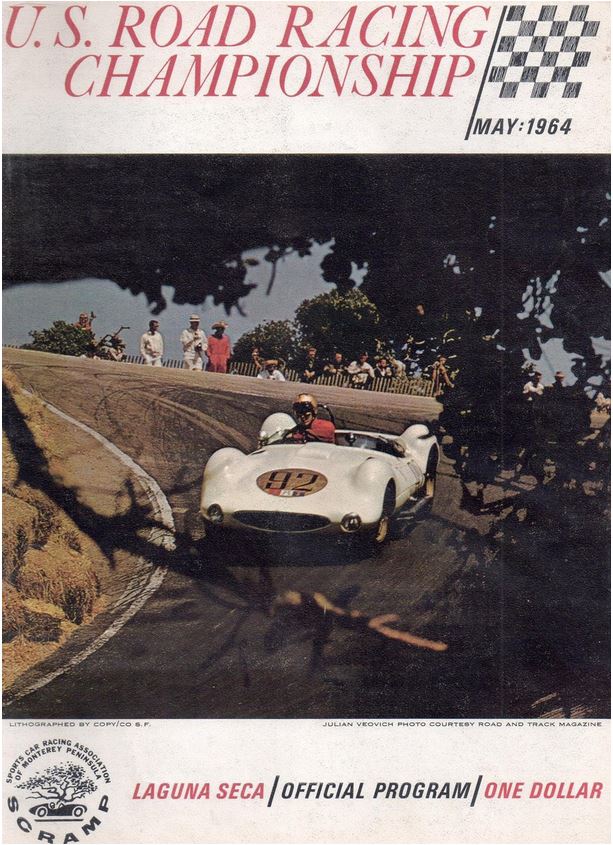
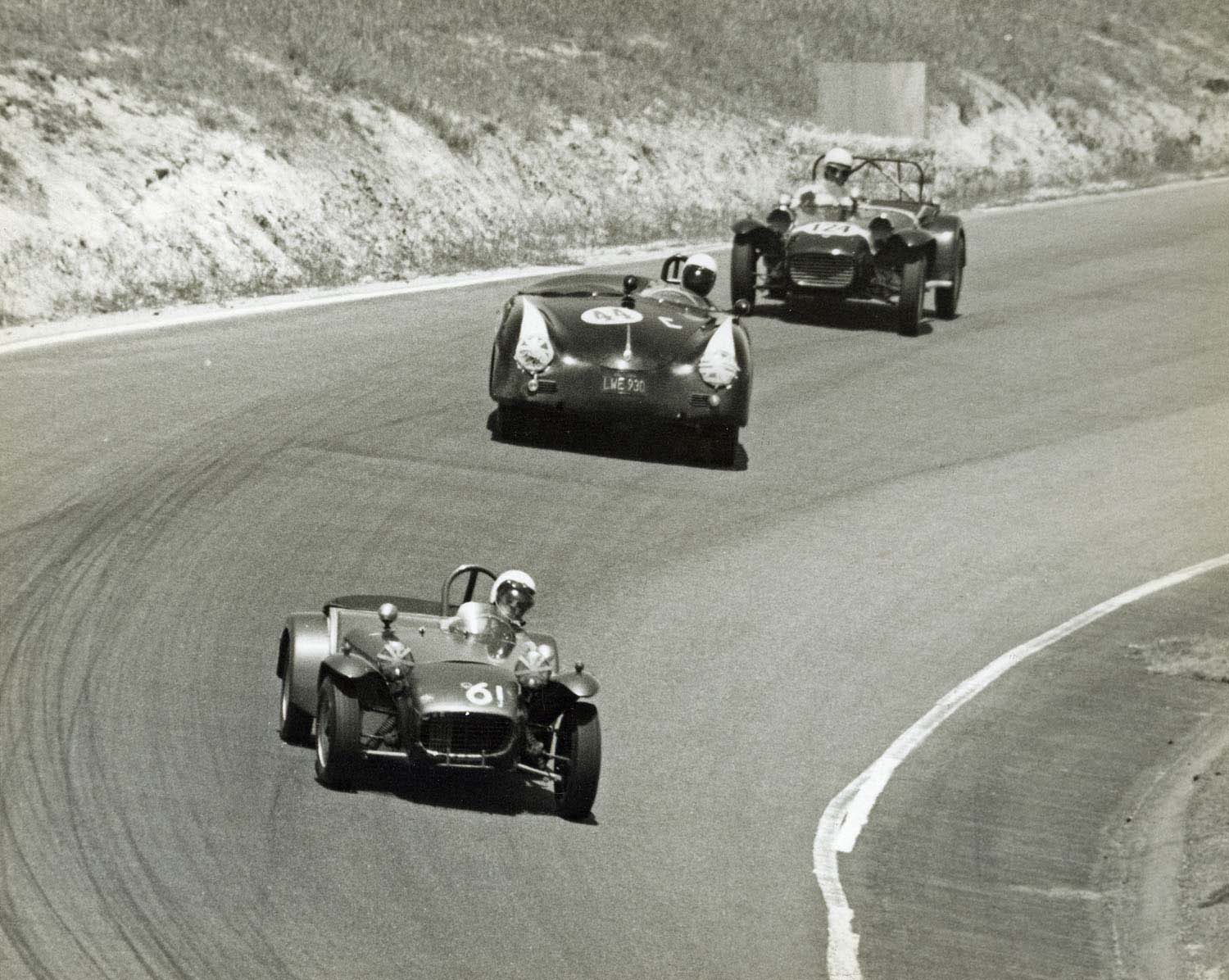
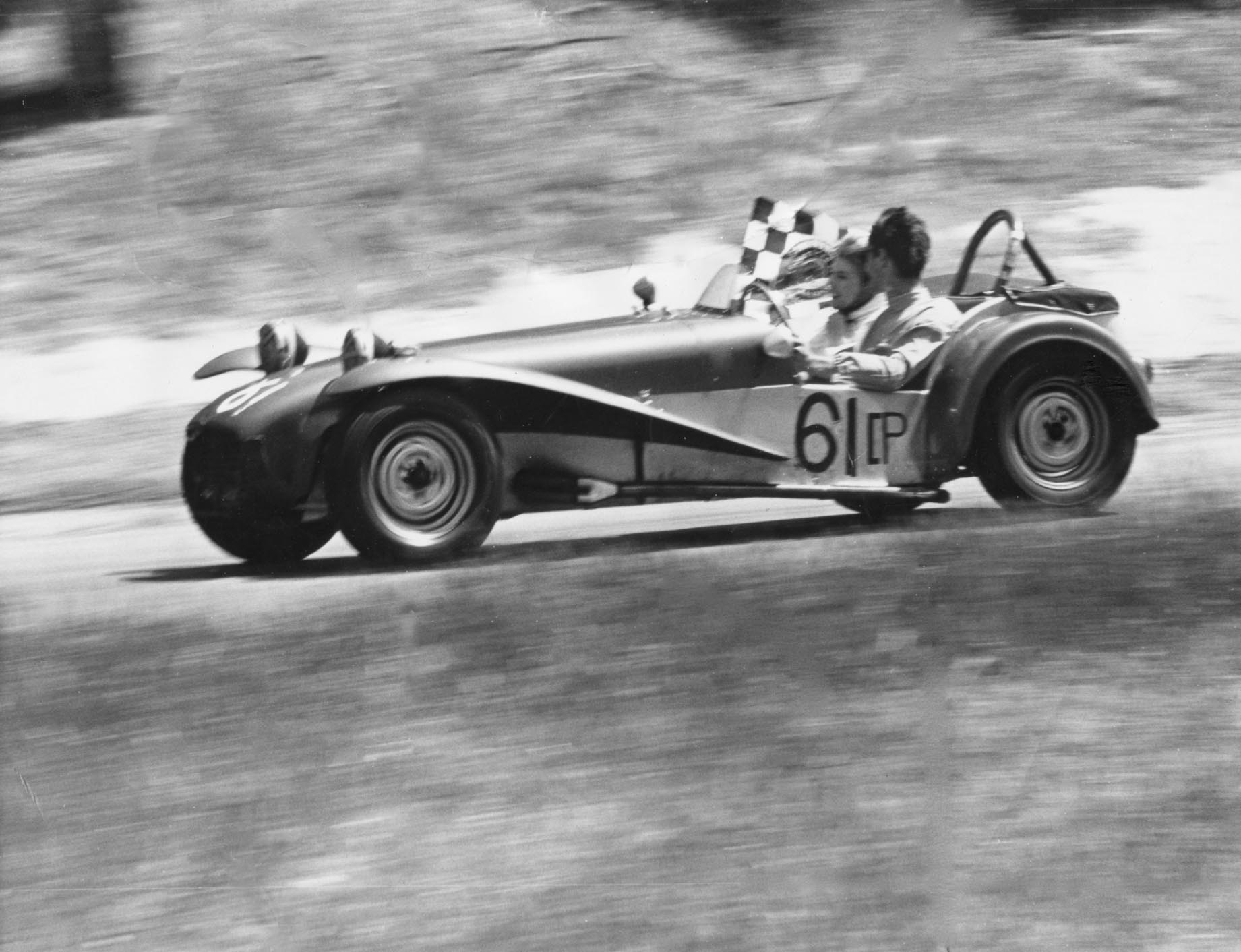
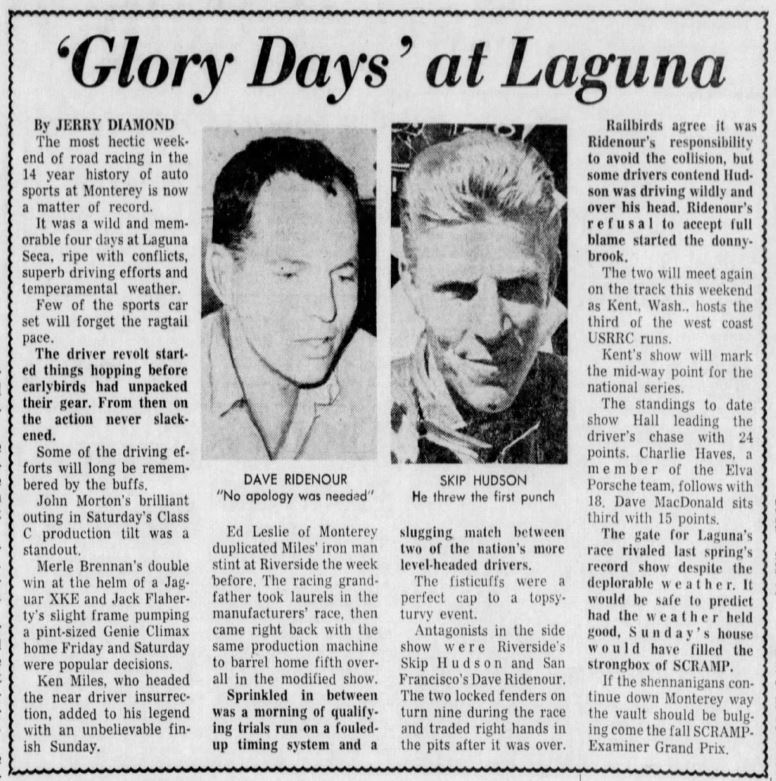
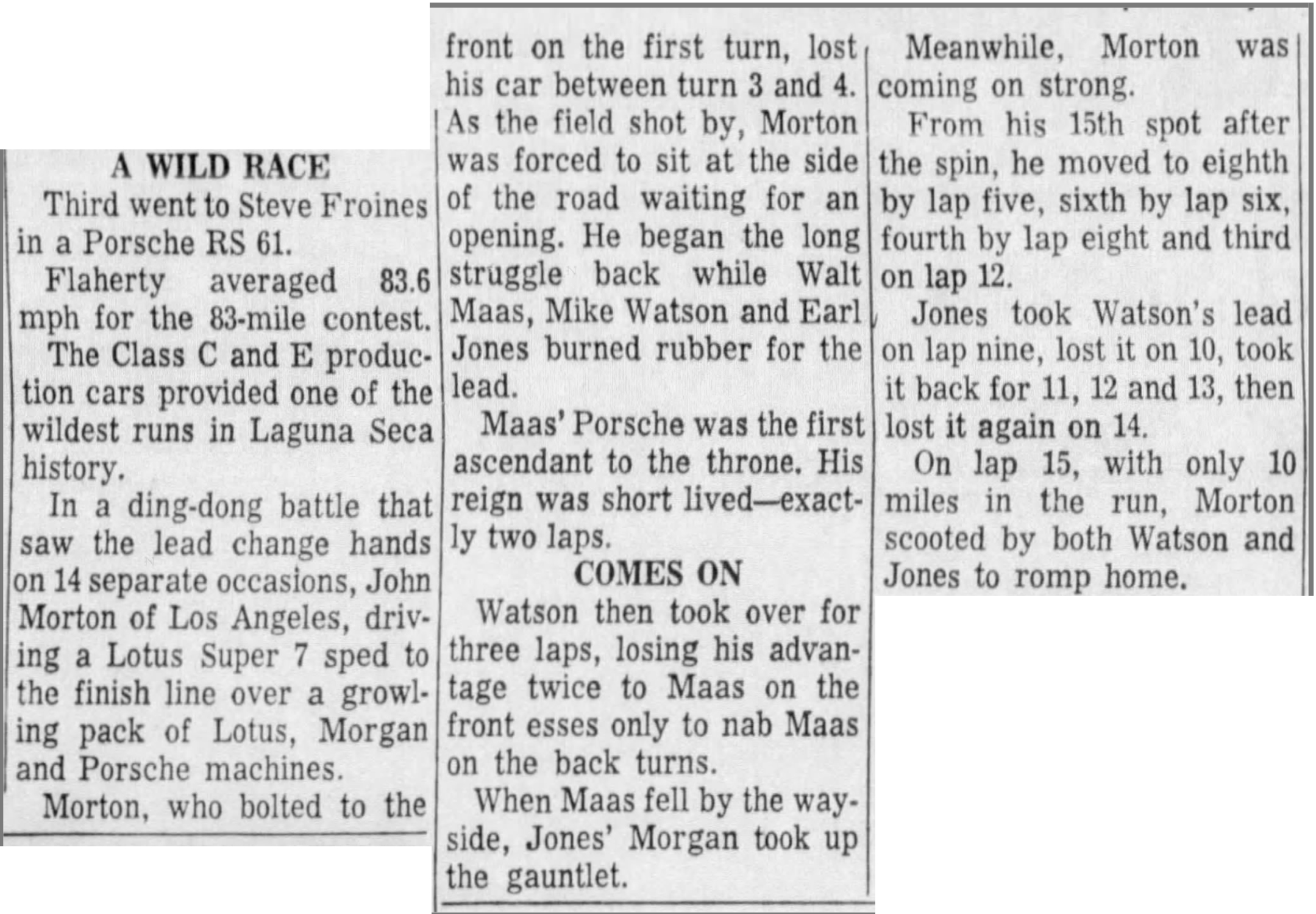
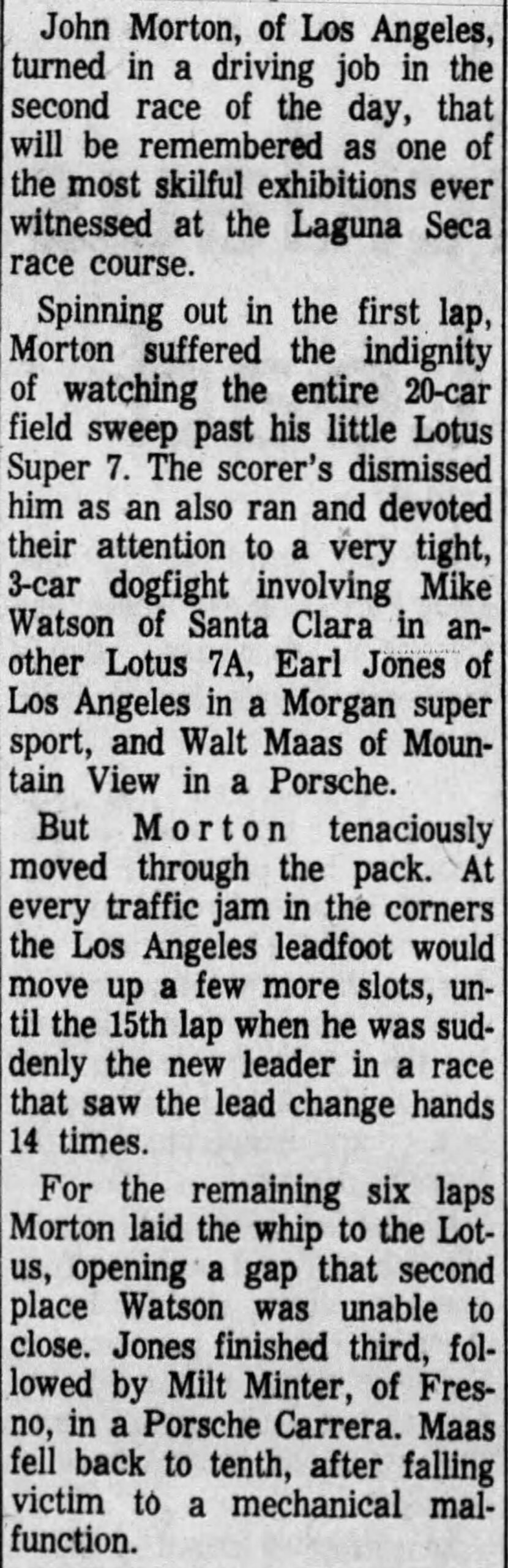
I got a very good start. My new close ratio gears helped with the standing start, still the standard starting procedure, and by turn three, I challenged a Porsche Carrera for the lead. I got partially along side him as he turned into the very fast left hand turn. We touched, his rear and my front, which caused me to spin. I had to sit beside the track until I could find an opening because it was the first lap with everyone bunched together.
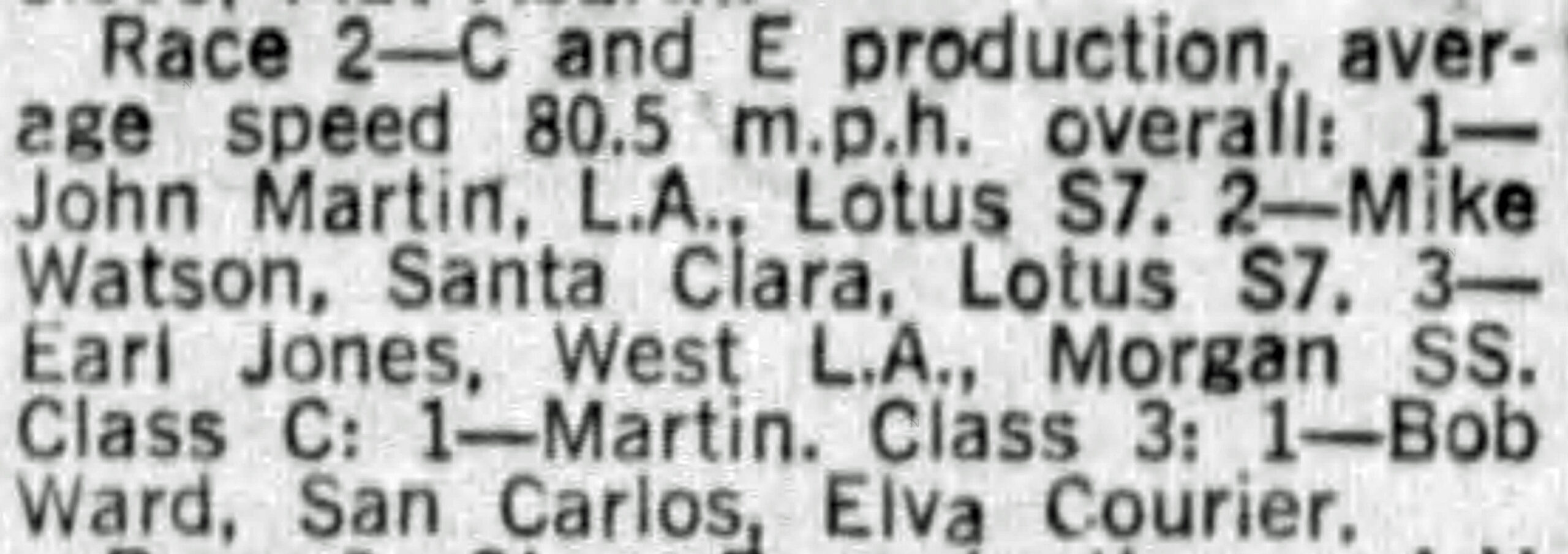
I rejoined the race way back about fifteenth. There had been no damage so I started passing the slower cars easily. The closer to the leaders I got, the longer it took to get by. I worked my way through most of the cars but time was running out. There was my friend Earl Jones in his Morgan up ahead. I caught him and got by with only a few laps to run. Earl had been running second but was challenging Mike Watson for the lead when I passed him. Watson was driving a Lotus Super 7 too but mine was better; I passed him and with only two or three laps remaining, I pulled away for a very satisfying victory, both for me and for my friends who had endured a tough few days to help me.
John Morton collection – San Francisco Examiner
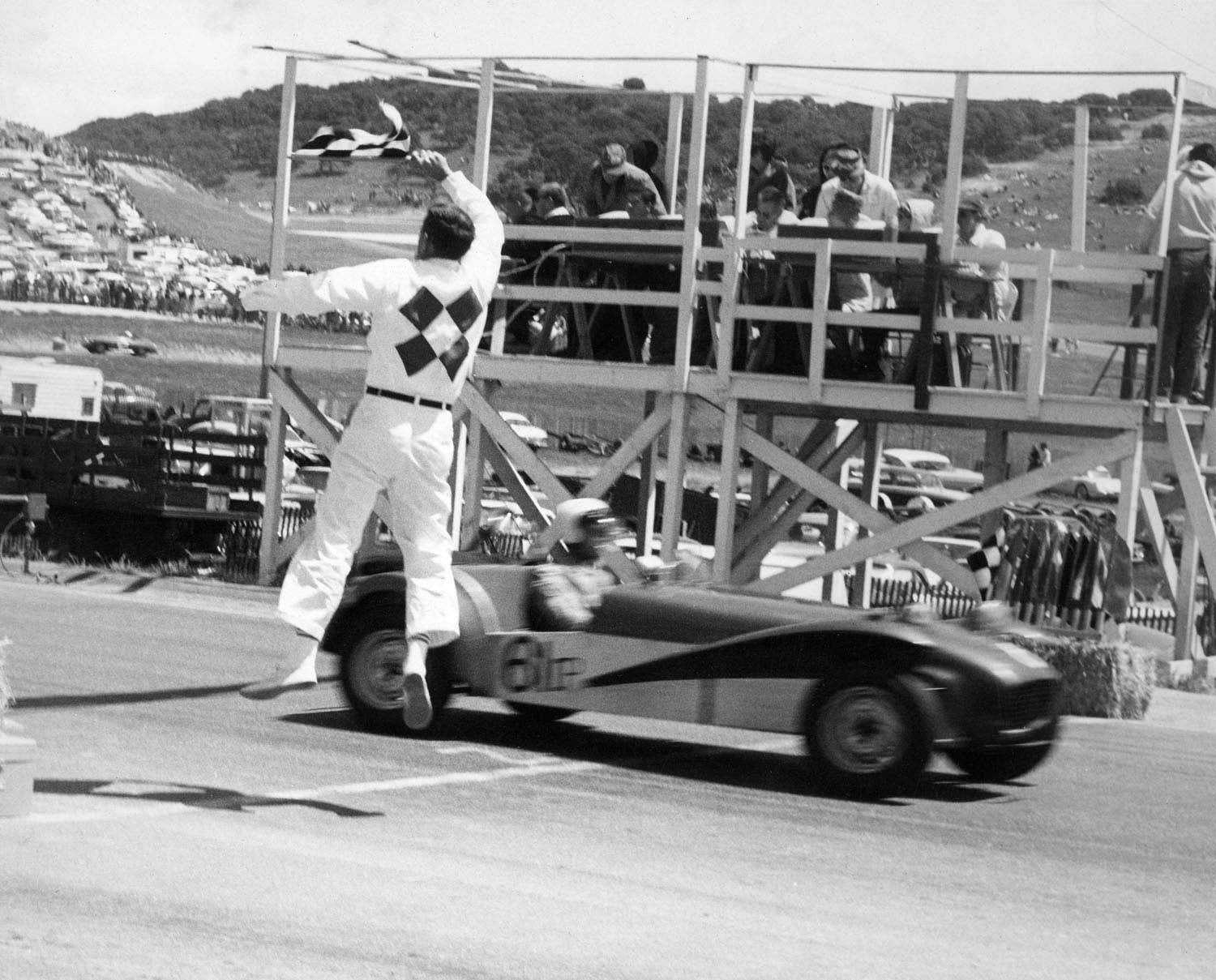
Morton collection – Dave Friedman photo
Del Mar SCCA Divisional
Lotus Super 7
May 17, 1964
1st in class
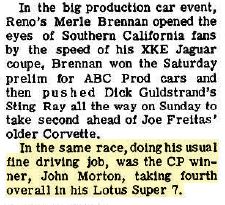
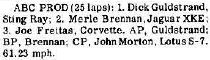
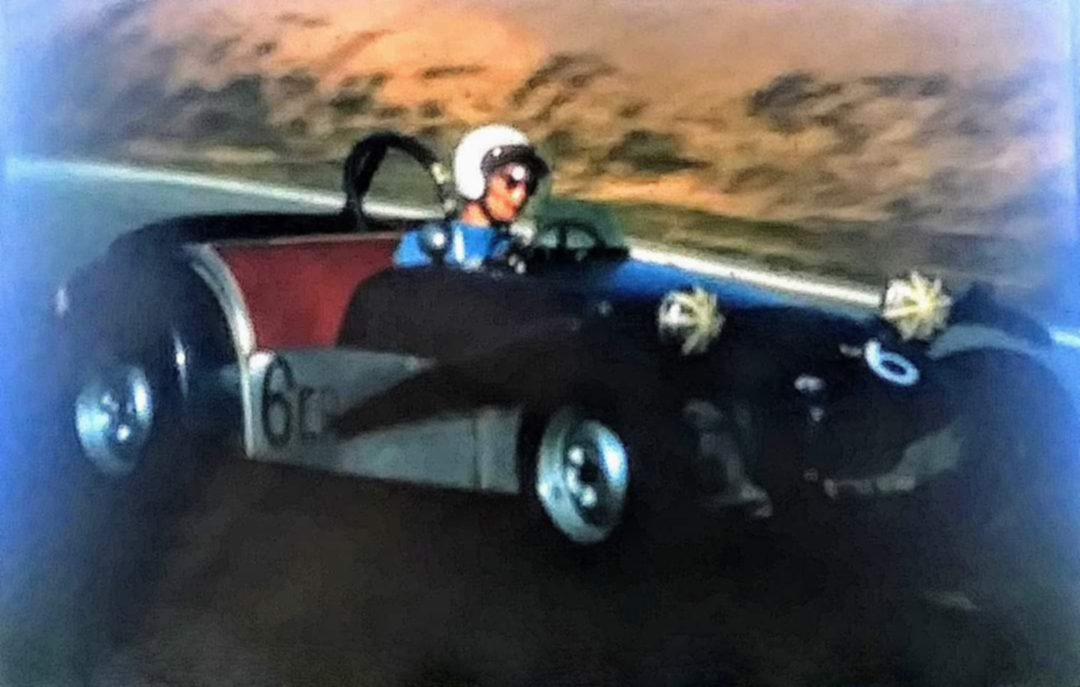
“SCCA Divisional race at Del Mar. Only George Boskoff came with me. The track was just like it was the year before when I won the novice race, but for some reason now the car had too much understeer. We tried to cure the problem by changing to different front tires but it didn’t help. During the race I was able to keep Earl Jones and his Morgan in sight but I couldn’t catch him, much less pass until his left front spindle broke and his wheel went flying off the track, just like Lew Spencer’s had at Dodger Stadium. I won but Earl should have; it wasn’t a very satisfying victory.”
Morton collection
Lotus 23B (Chassis S55)
“I went back to see Bob Challman, the Lotus dealer, to see about trading my Super 7 on a new Lotus 23B with an English Ford Twin Cam engine. He tried selling me a slightly used one that had been driven by Jim Clark to win the under two-liter class at the 1963 Times GP but I said, “I want a new one.”
It was only five hundred dollars more. I don’t remember what he gave me for the Super 7 in trade, but it had been a car that exceeded my most optimistic expectations and deserved better than to just be cast aside as a used car. But since I was eager to move up, there wasn’t time for sentimental attachments. Or well thought out decisions.
There was a big professional race called the Players 200 at Mosport in Canada, about 65 miles north of Toronto, on June sixth, the week after Indy. Carroll said I could put my new Lotus in the transporter and Shelby American would enter it as a team car along with Cobras for Ken Miles and Bob Johnson as well as a King Cobra for Dave MacDonald. It was very generous of Carroll to do this and also to paint my car Viking blue, the team color, in our paint shop.
I had never driven a rear engine car so was very eager to drive my new car before it went to Canada. Ken Miles was going to do a test on his Cobra before it left for Canada so I tagged along to Riverside with the 23.
Very quickly I discovered that a car with the engine in the back felt very different from my Super 7, or the Cobras I had driven at drivers’ school and Sebring. I felt that something might be wrong with the suspension and wanted a second opinion. Ken was out of the Cobra for the time being so I asked him I he’d mind taking a couple of laps in my Lotus and give me his impression. He drove two or three laps, came in and said, “It’s fine. Nice little car.”
Mosport Park Player’s200
June 6, 1964
Lotus 23B (S/N S55)
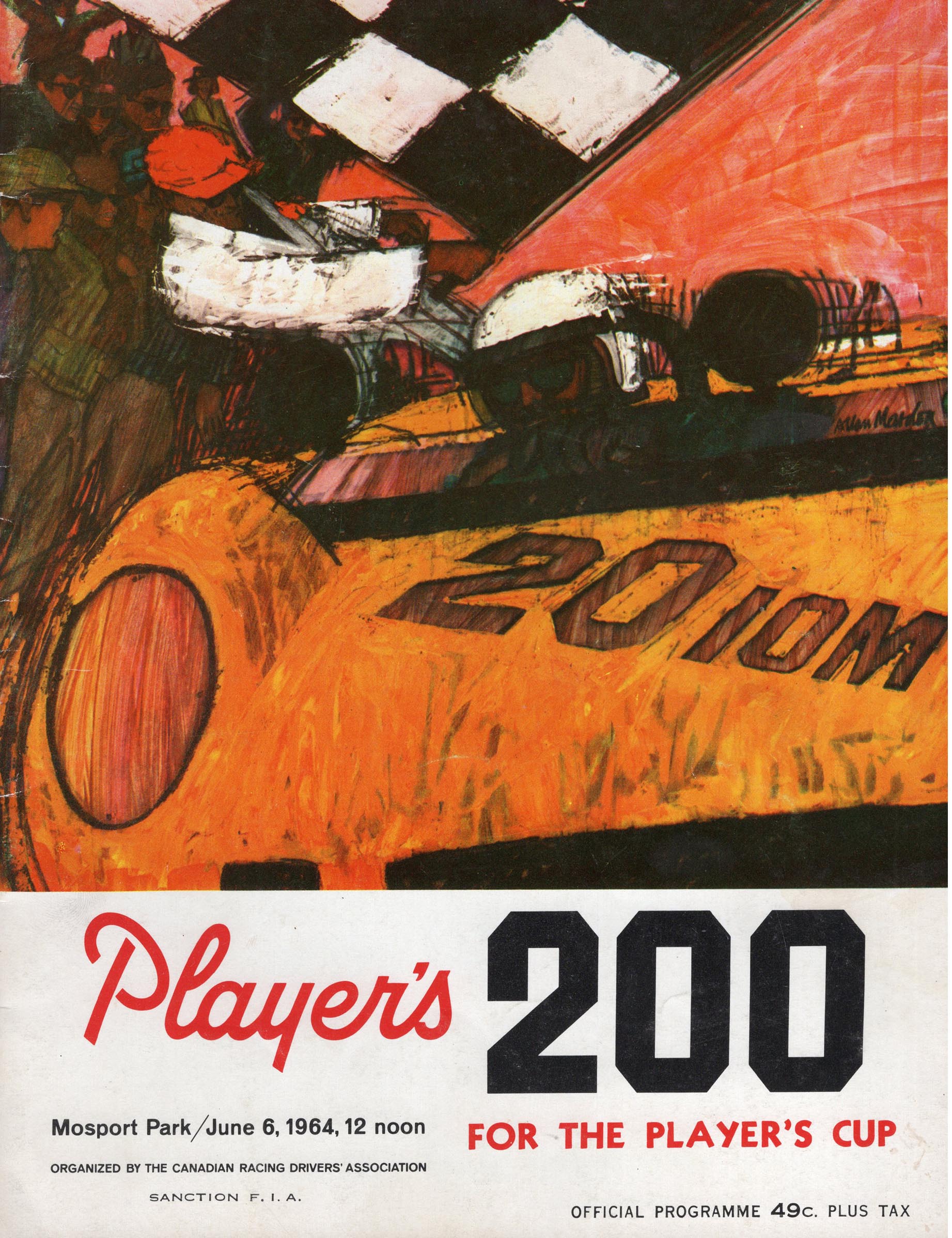
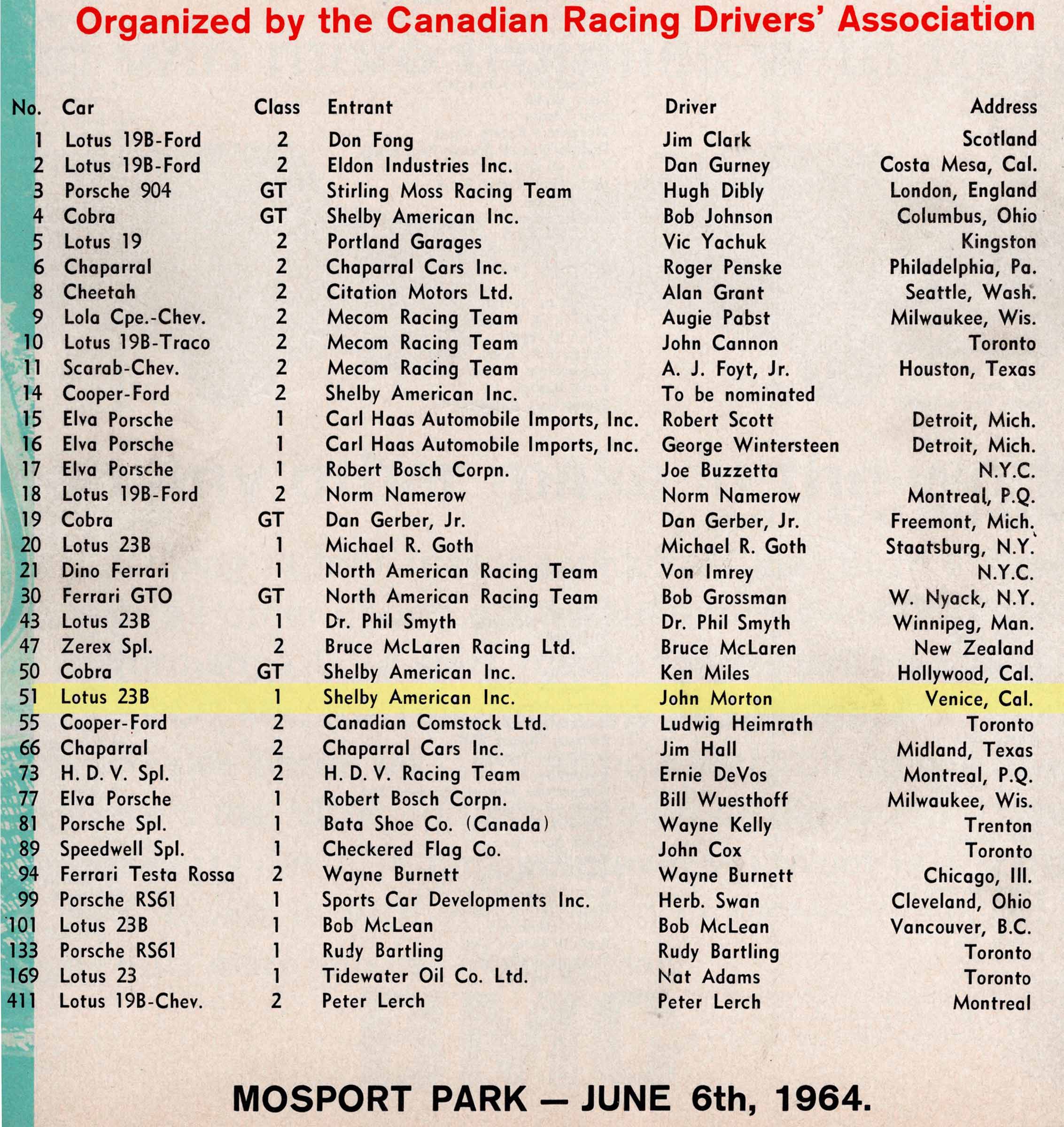
“The drivers entered in this race were among the best in the world including World Champion Jim Clark, Formula One drivers Dan Gurney and Bruce McLaren as well as A. J. Foyt who, less than a week earlier, had won the tragedy marred Indy 500 for the second time. Foyt and Augie Pabst were driving for the Mecom team, Foyt in the one and only rear engine Scarab that had been purchased from Lance Reventlow with Pabst in the Lola GT, the forerunner to the Ford GT 40. Bruce McLaren was driving the ex-Roger Penske Zerex Special now with Oldsmobile V-8 power replacing the Coventry Climax engine. Jim Hall and Roger Penske were in Chaparrals.
Nearly half of the field was made up of under two liter cars, many Lotus 23s like mine. Bob McLean and Mike Goth were in 23s. Potentially the fastest under two liter cars were the Robert Bosch Special Elva Porsches of Bill Wuesthoff and Joe Buzzetta and the similar Carl Haas-entered cars for Skip Scott and George Wintersteen.”
#50 Ken Miles (CSX2128) leads John in his #51 Lotus 23B (S/N S55). Bob Johnson (CSX 2026) in #33 at rear of pack.
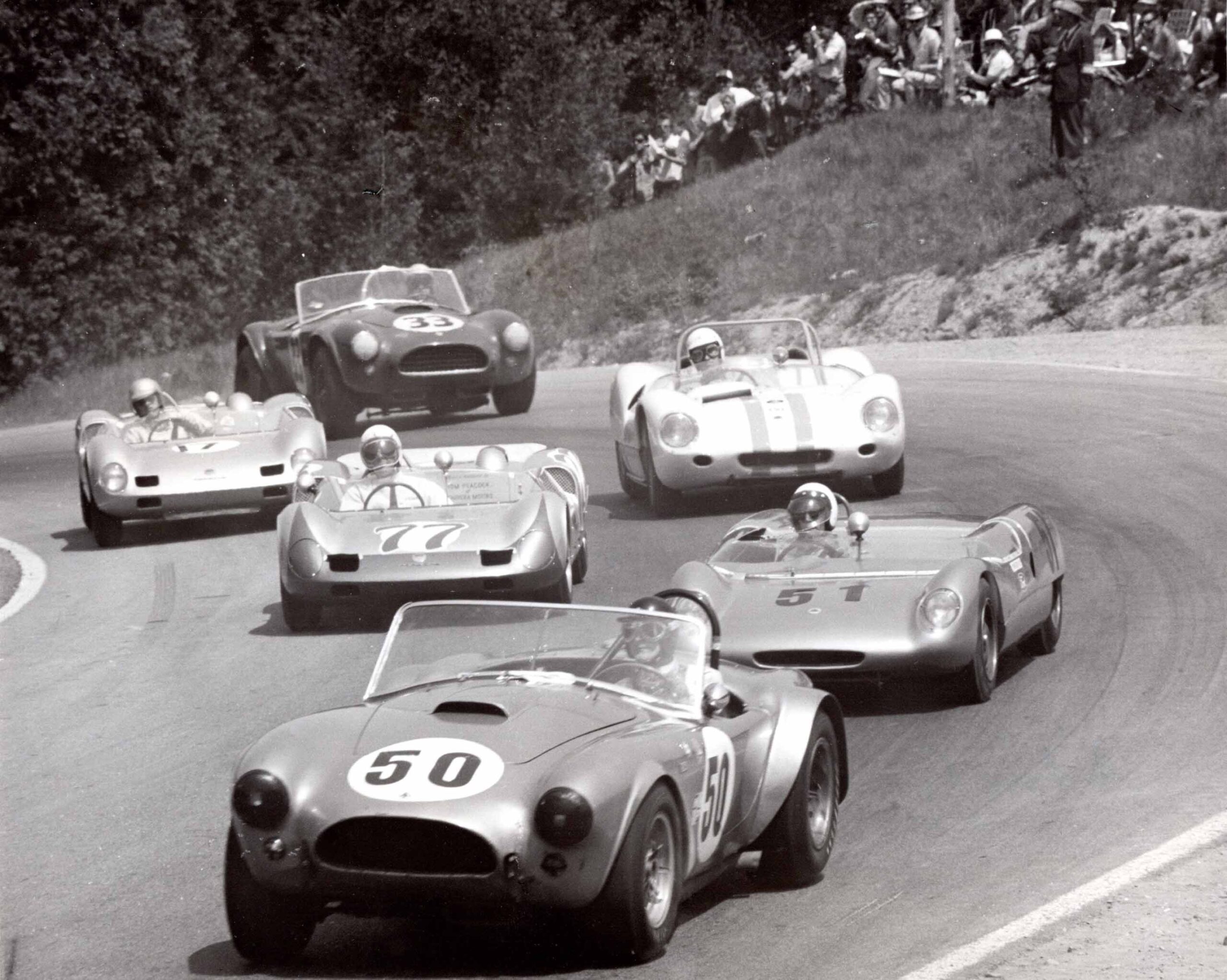
Morton collection – Dave Friedman photo
John’s Lotus was supported and entered by Shelby in some of the 1964 USRRC races, and was transported in the Shelby truck with the other team cars.
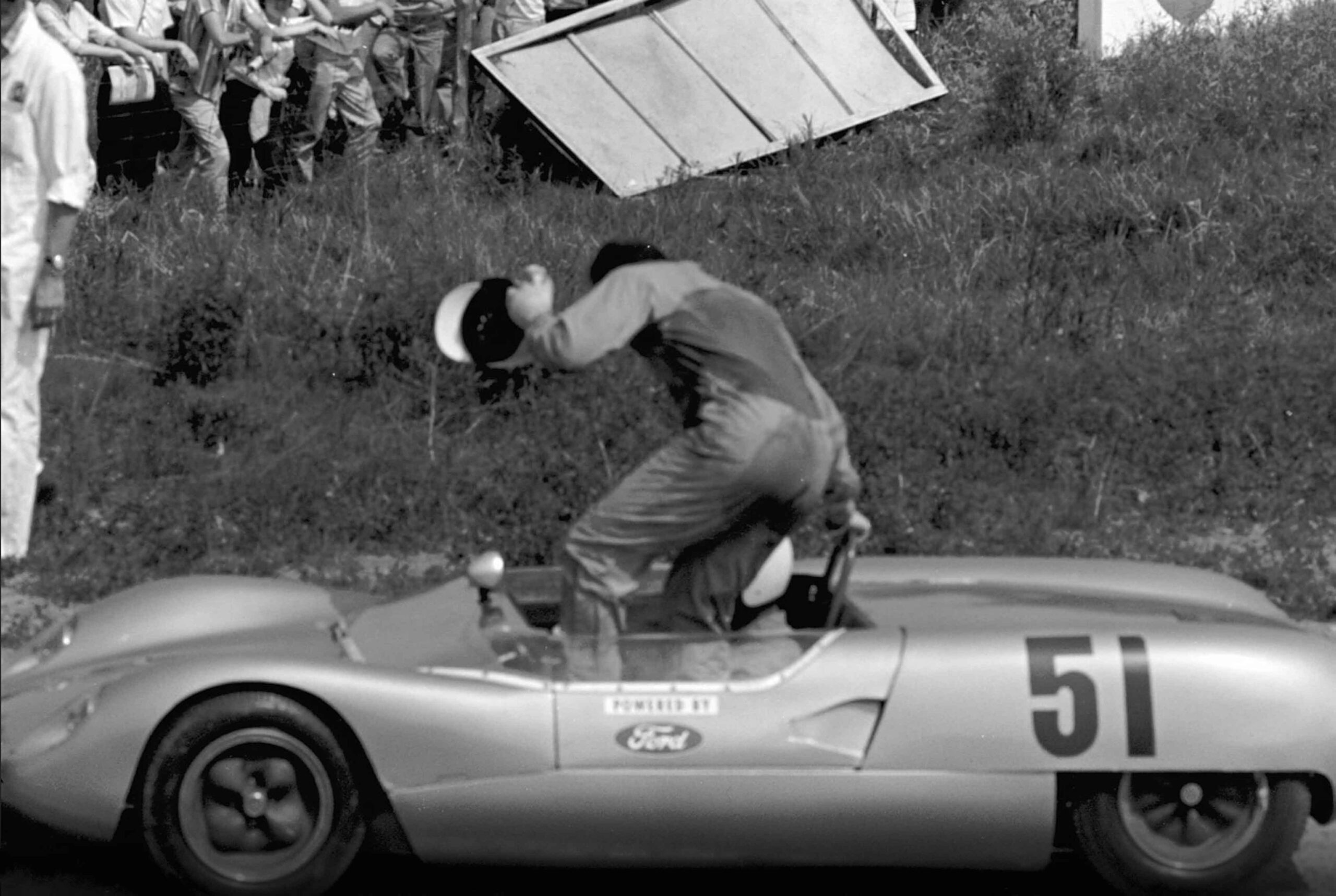
Morton collection – Dave Friedman photo
John picking up Ken Miles on the track after Miles’ Cobra failed to finish the race.
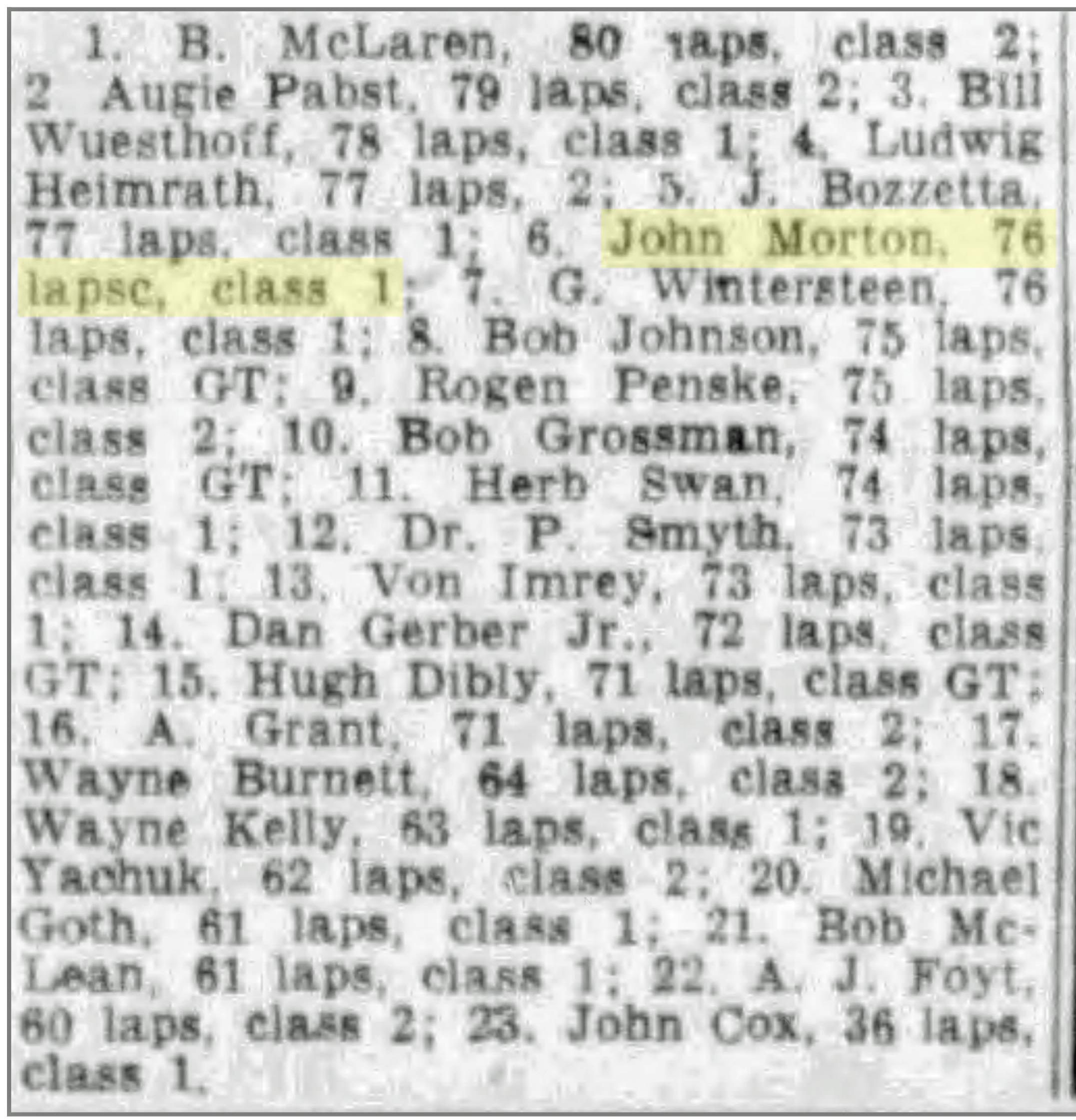
The race was run in two hundred mile heats with about an hour between the two. I spun in the first heat, letting Buzzetta by and finished third. In the second heat I spun again, this time twice in the same lap. I had to take it easier for the rest of the race to keep from making more mistakes. I lost concentration as the race wore on; something I really needed to work on. I still finished third in the under two-liter class.
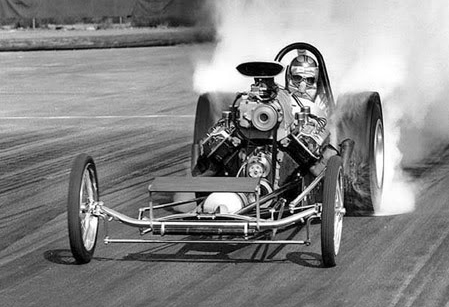
Pomona Raceway Drag Strip
Bob Skinner and Tom Jobe Dragster
Lions Drag Strip
June, 1964
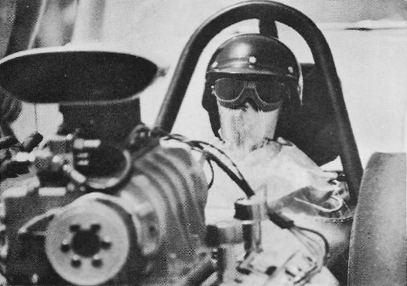
“The dragster ride happened when I was at Shelby’s. I got in the car at the strip. Really got packed in. I was sitting there in that thing thinking, ‘I have really got myself into something.’ Here I was a sports-car racer and had never driven anything down a dragstrip before, not even my dad’s car, and I was about to drive the fastest thing they made. I was scared shitless. The thing was so powerful the centrifugal force of the clutch was trying to push itself out. I revved the engine, and the sound ripped out like an explosion. My whole leg was trembling on the clutch.”
“I let it out. Everything was a blur, the whole world went fuzzy. I let off for a second, just a tiny bit, and got pissed off at myself and floored it again. On my other runs I never let off but it didn’t matter; the thing was so fast I did 180 mph my first run and that was it, never any faster. I put the clutch in at the end of the run and waited for the thing to stop. By the time it did, I could feel my leg was still shaking, like a dog shitting razor blades. But I did it. Something made me do it.”
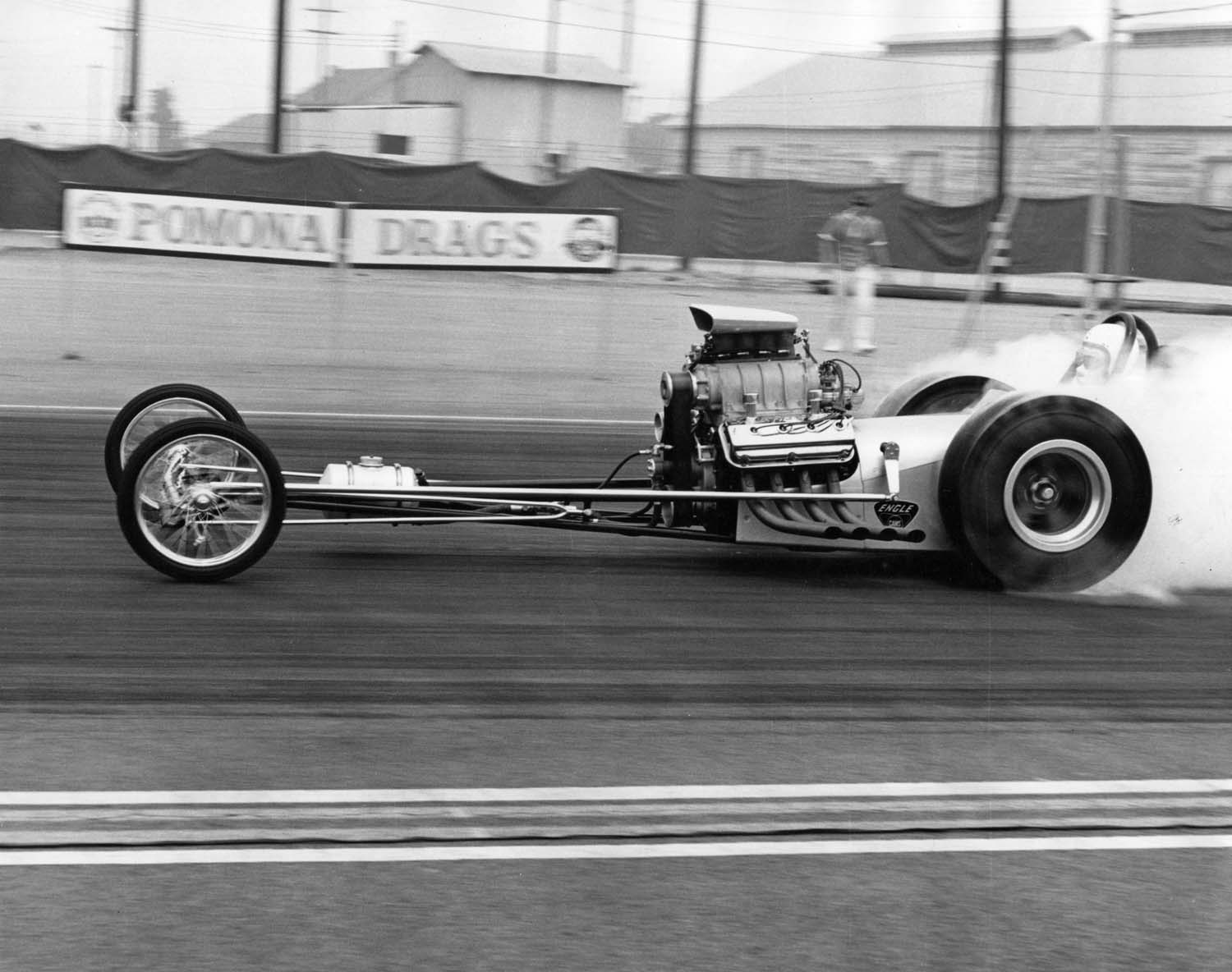
John Morton collection – Charles Strutt photo
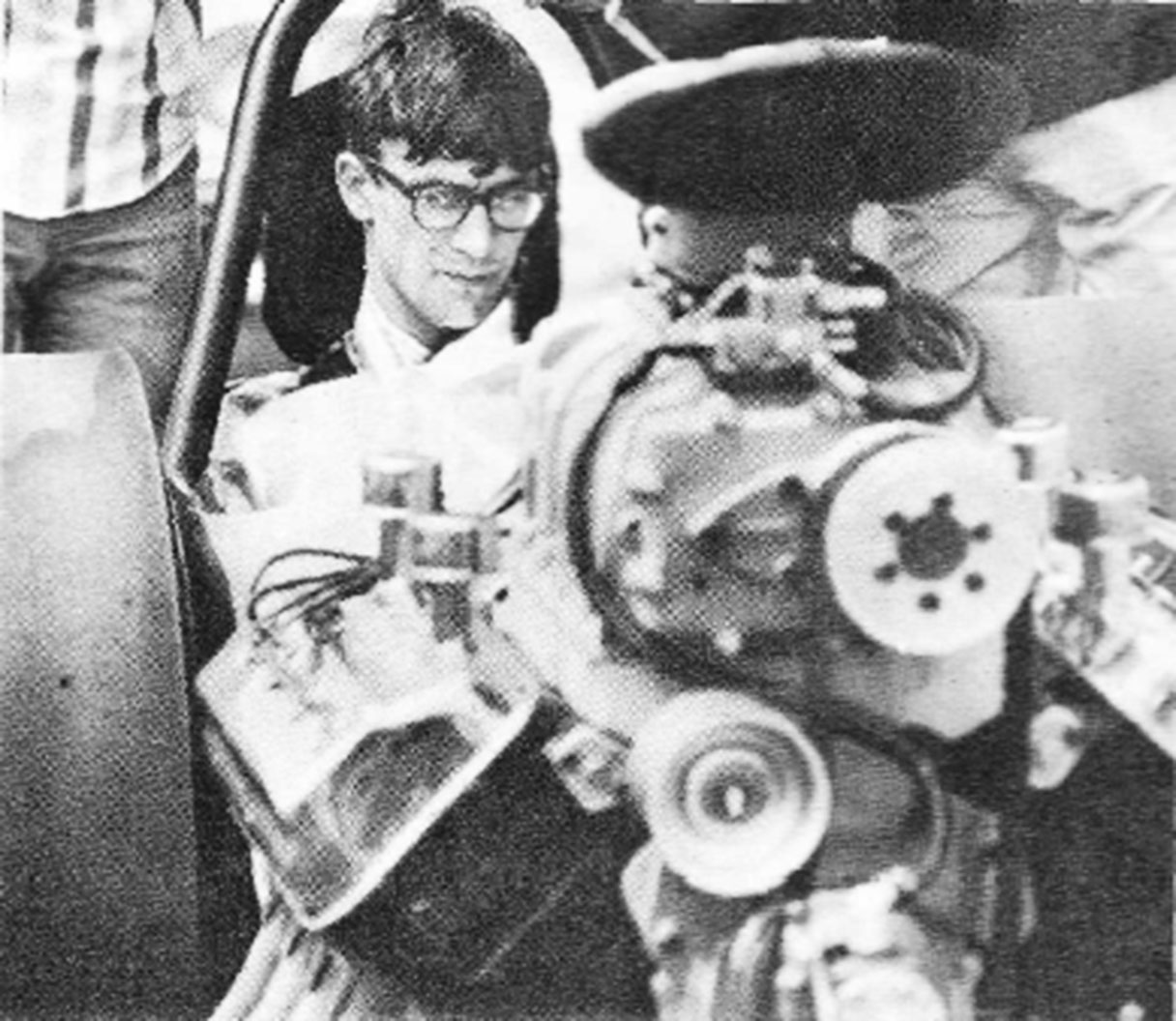
John Morton collection
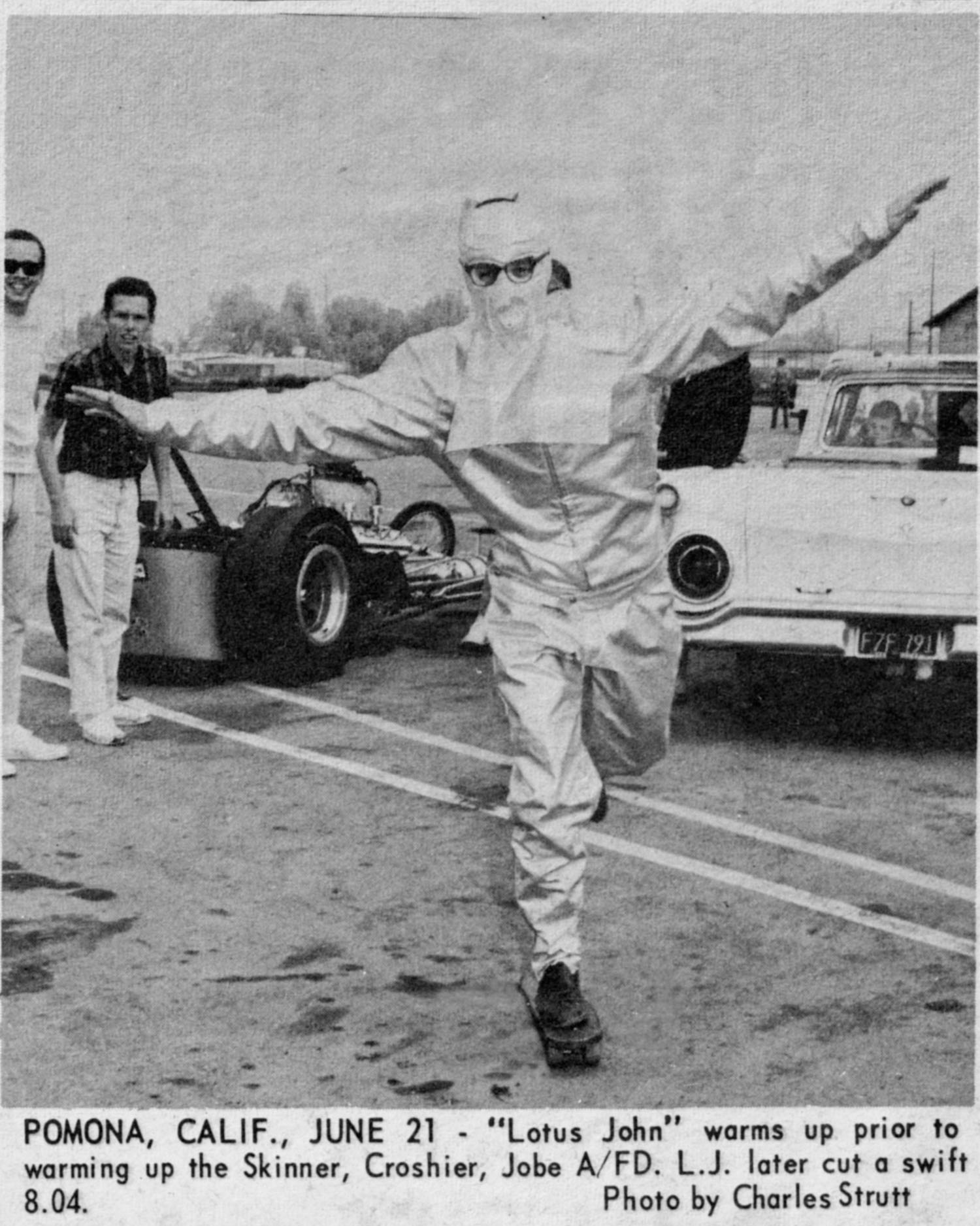
John Morton collection
Watkins Glen USRRC
June 27, 1964
Lotus 23B
7th overall
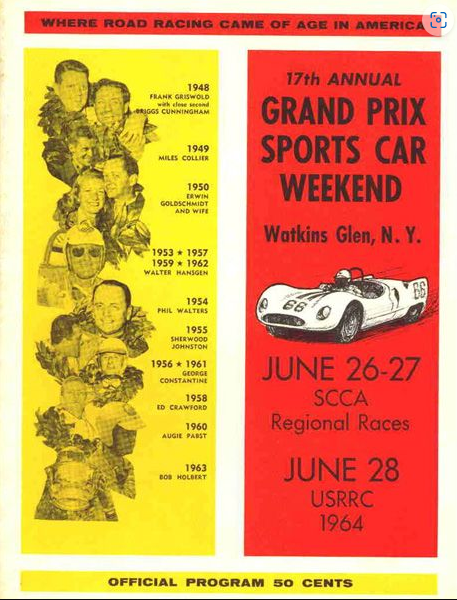
“I did finish third in under-two liter behind two Elva Porsches driven by Charlie Hayes and Don Wester. Jim Hall and Roger Penske were first and second in Chaparrals with Miles fifth; I was seventh overall.”
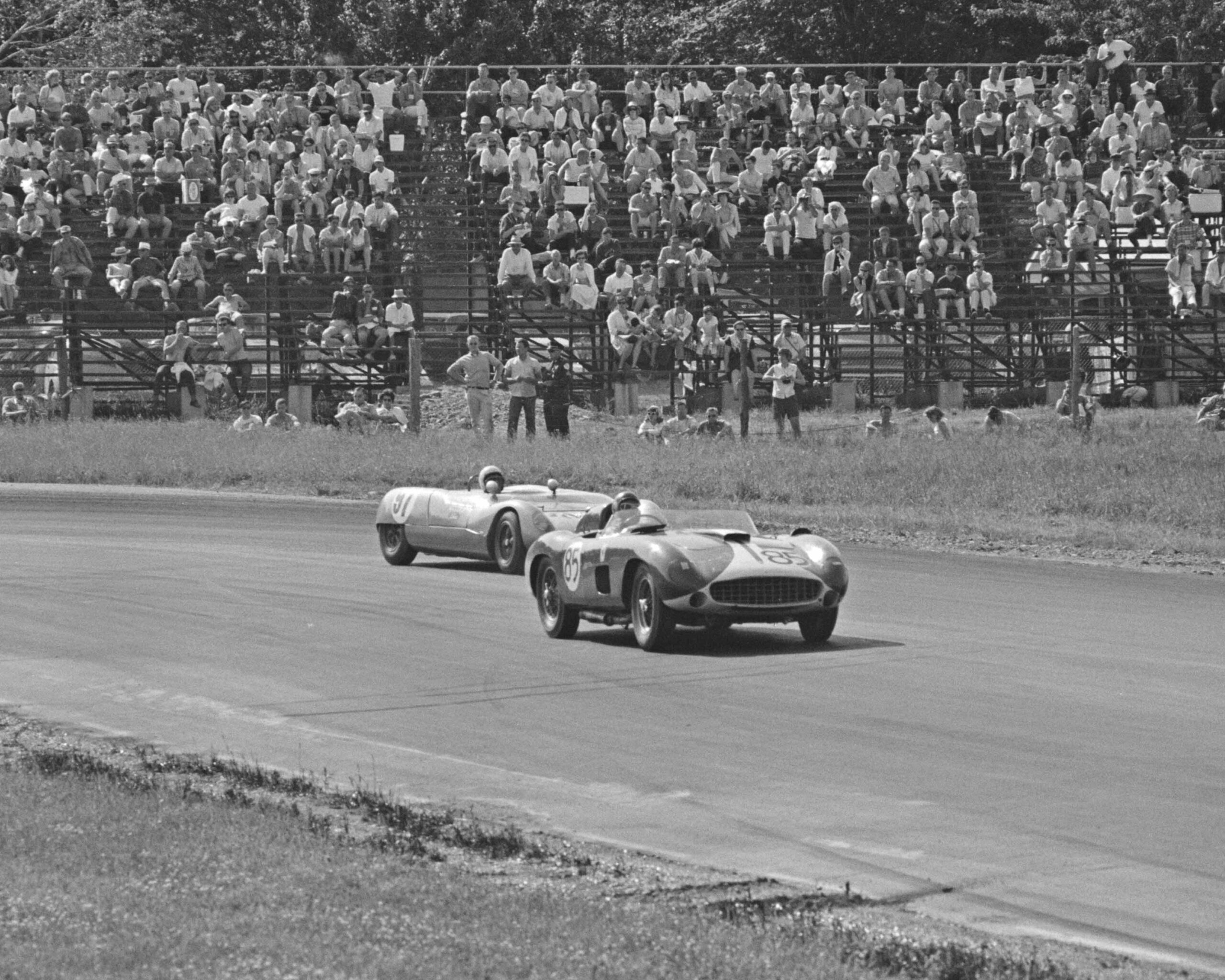
Morton collection – Karl Ludvigsen photo
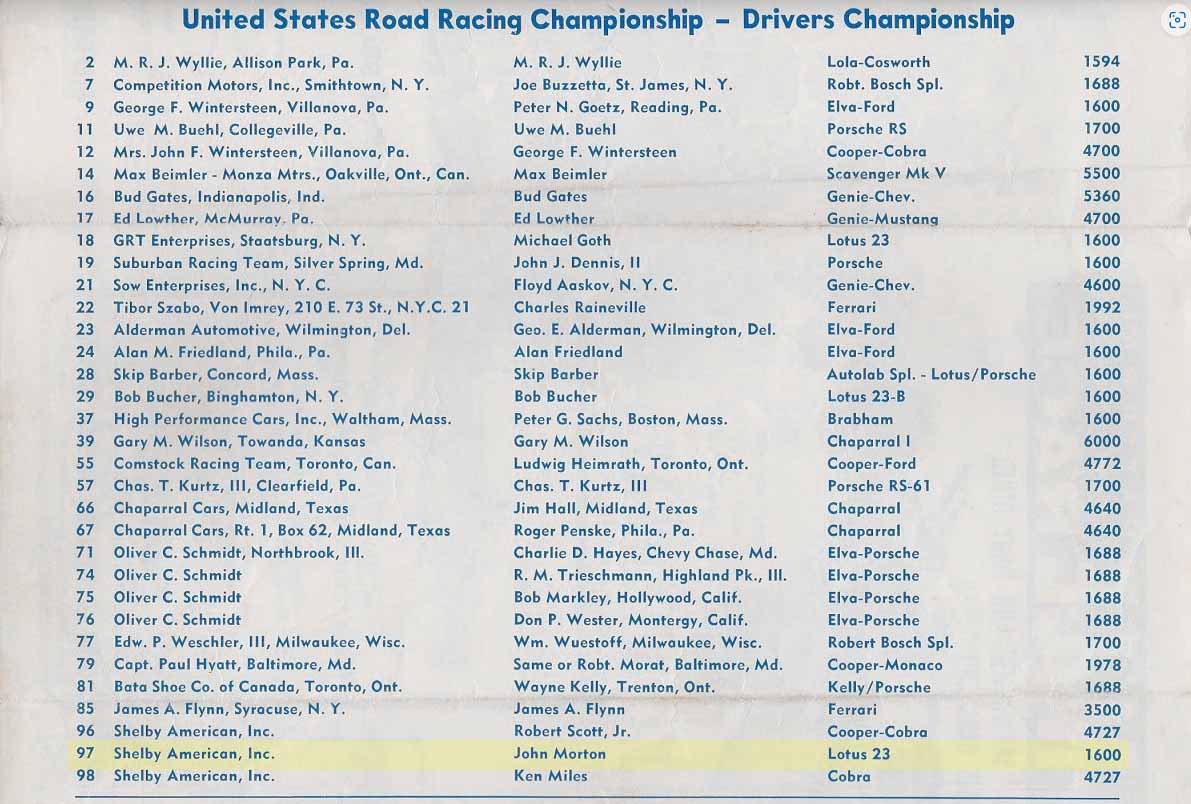
Greenwood Roadway USRRC races
Indianola, Iowa
Lotus 23B
July 19, 1964
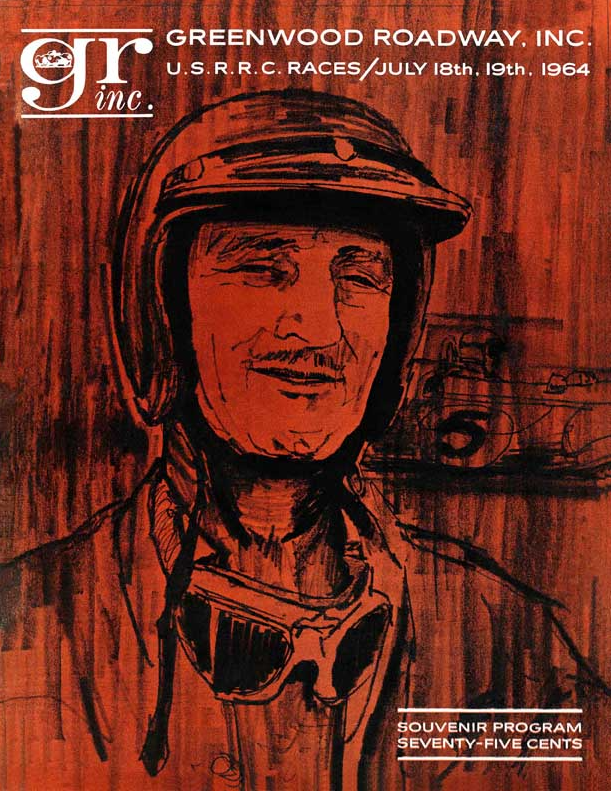
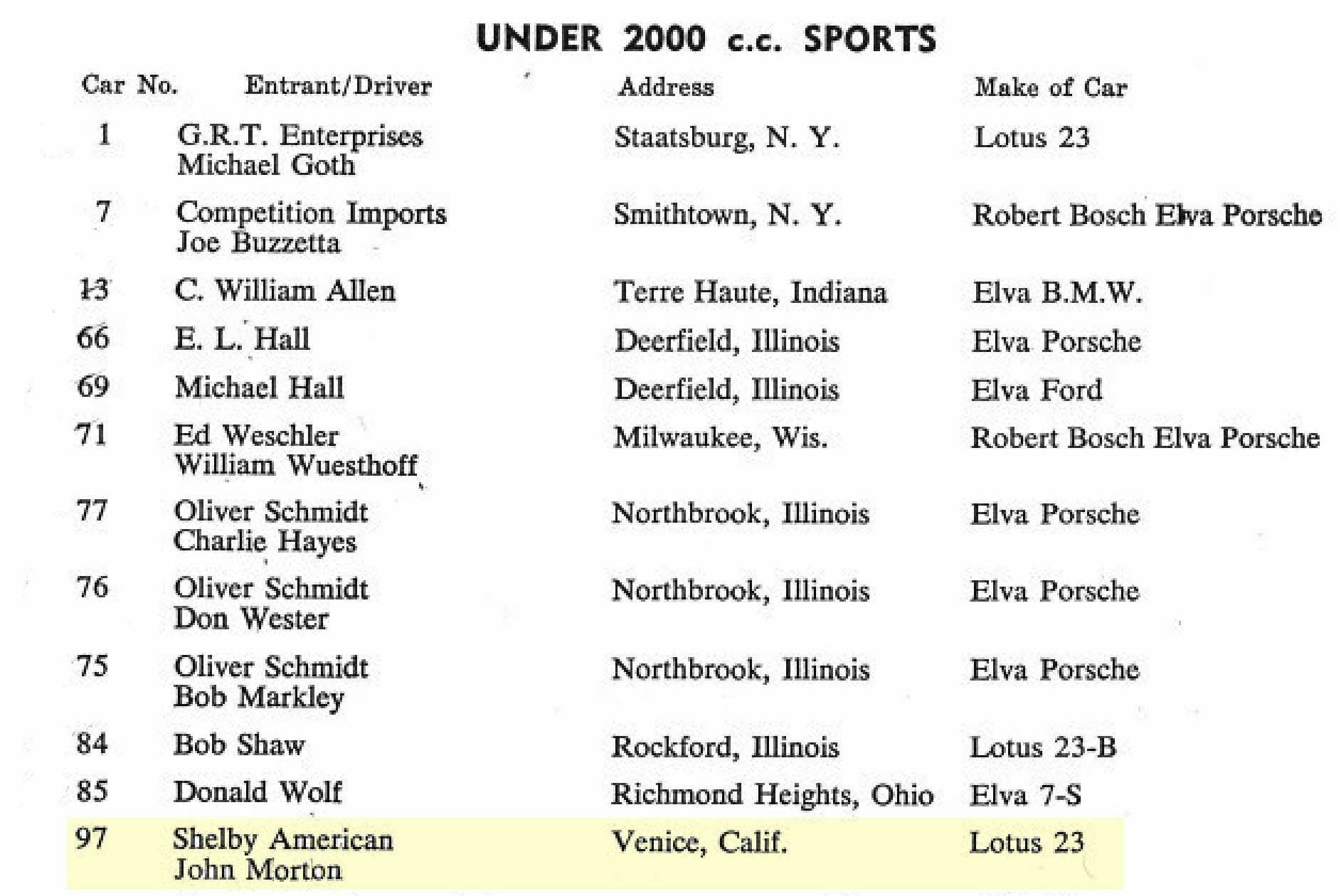
“Greenwood Roadway, which had been so good to me and my Super 7 less than a year earlier, extracted its revenge Saturday during practice when my engine blew. After being towed to the paddock I lifted the rear body to reveal engine parts scattered on the belly pan; the crankshaft had broken. My dad, ever the optimist, looked at the broken engine and proclaimed: “Well, it looks like you’re not going to get killed today.”
Road America 500
September 13, 1964
289 Cobra #CSX2494
1st in class
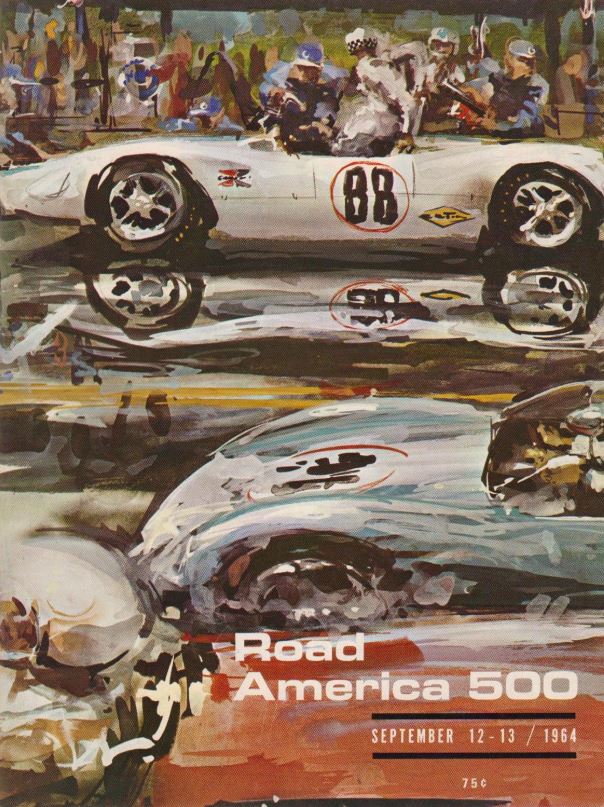
“With two USRRCs left in the 1964 season, I was told I would be driving a team Cobra in the final race, the Road America 500 at Elkhart Lake, Wisconsin. The Cobra was certainly a different animal from the Lotus Super 7.
The Shelby American team qualified first, second and third among GT cars. It was decided by someone on the team that I would start the race. Skip pitted on lap 86 and Miles replaced me for the last thirty-nine laps. Ten laps from the end, Ken passed the Penske/Hap Sharp Chevrolet Grand Sport to finish second overall behind the Walt Hansgen/Augie Pabst Ferrari 250 LM and we won the GT class.”
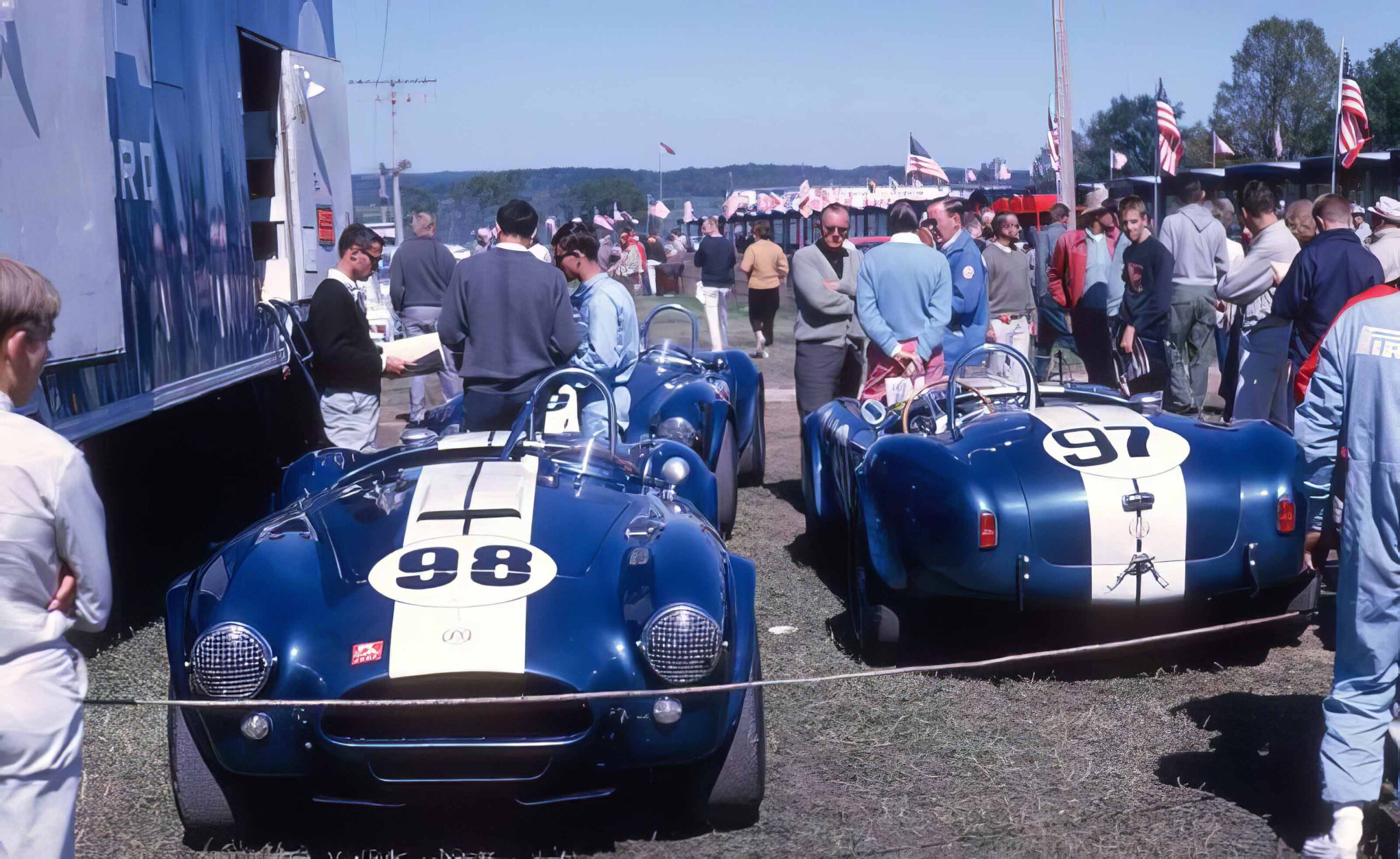
Morton collection
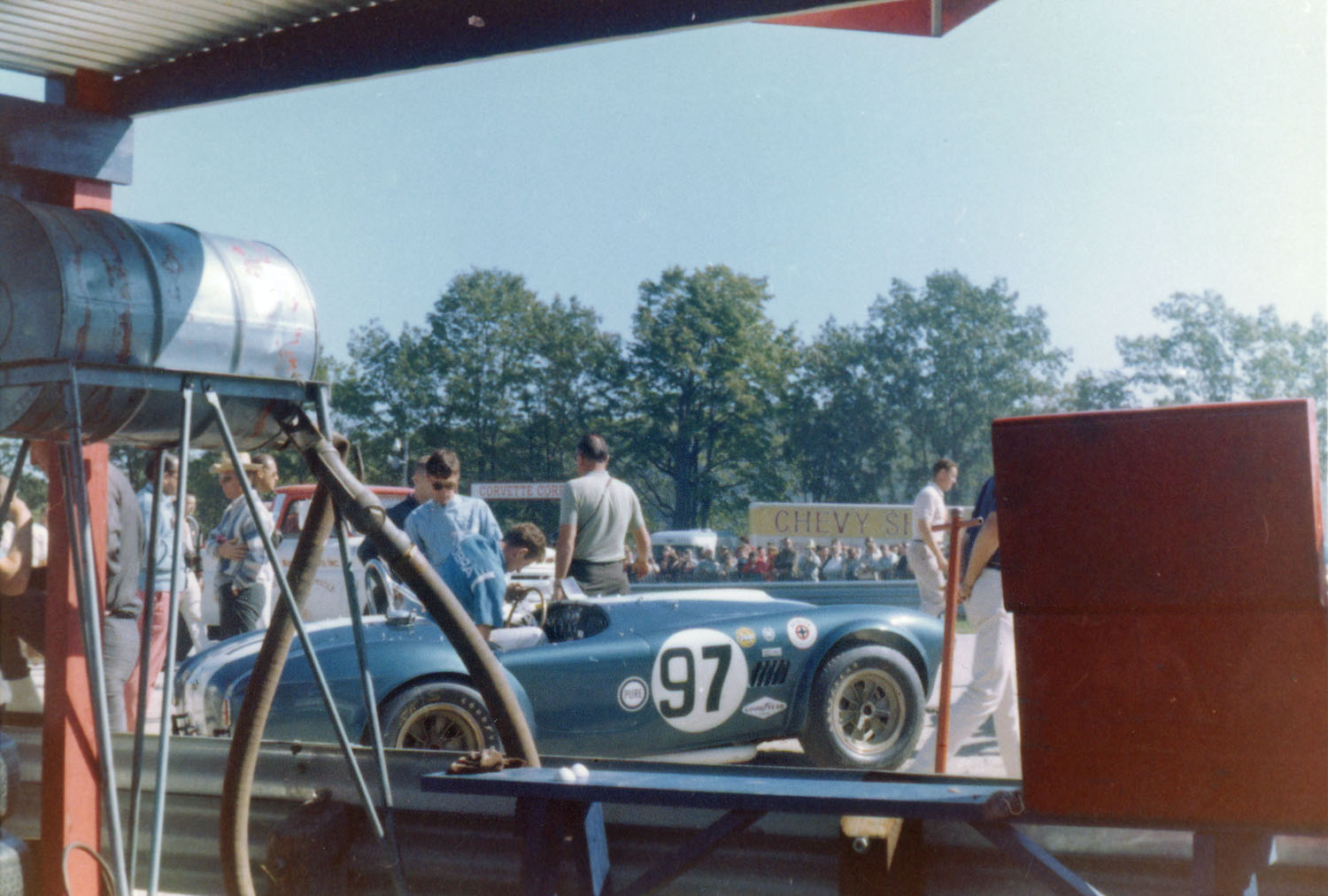
Morton collection
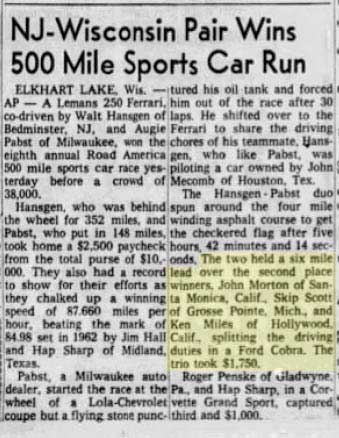
The Sacramento Bee
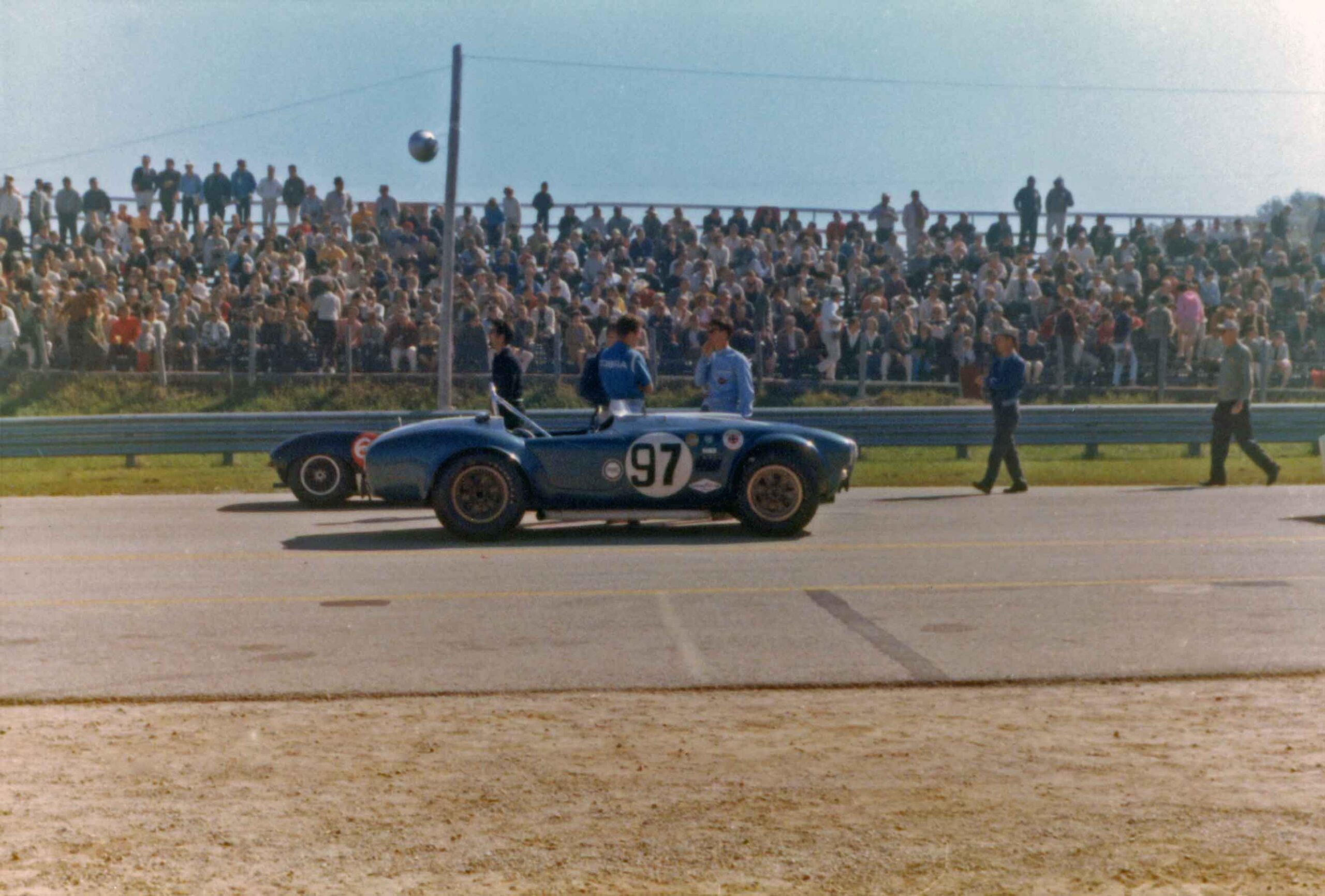
Morton collection
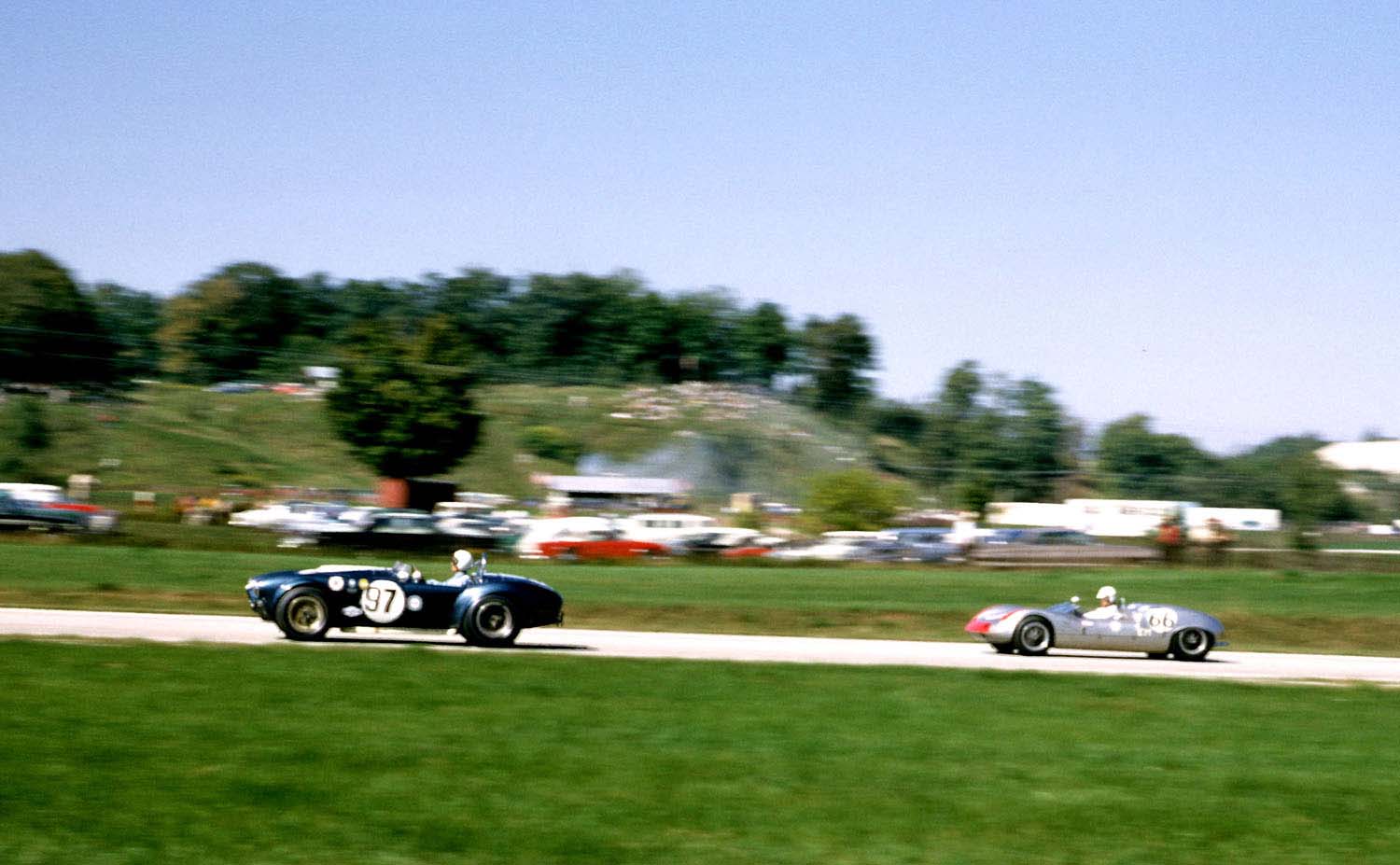
Morton collection – Tom Shultz photo
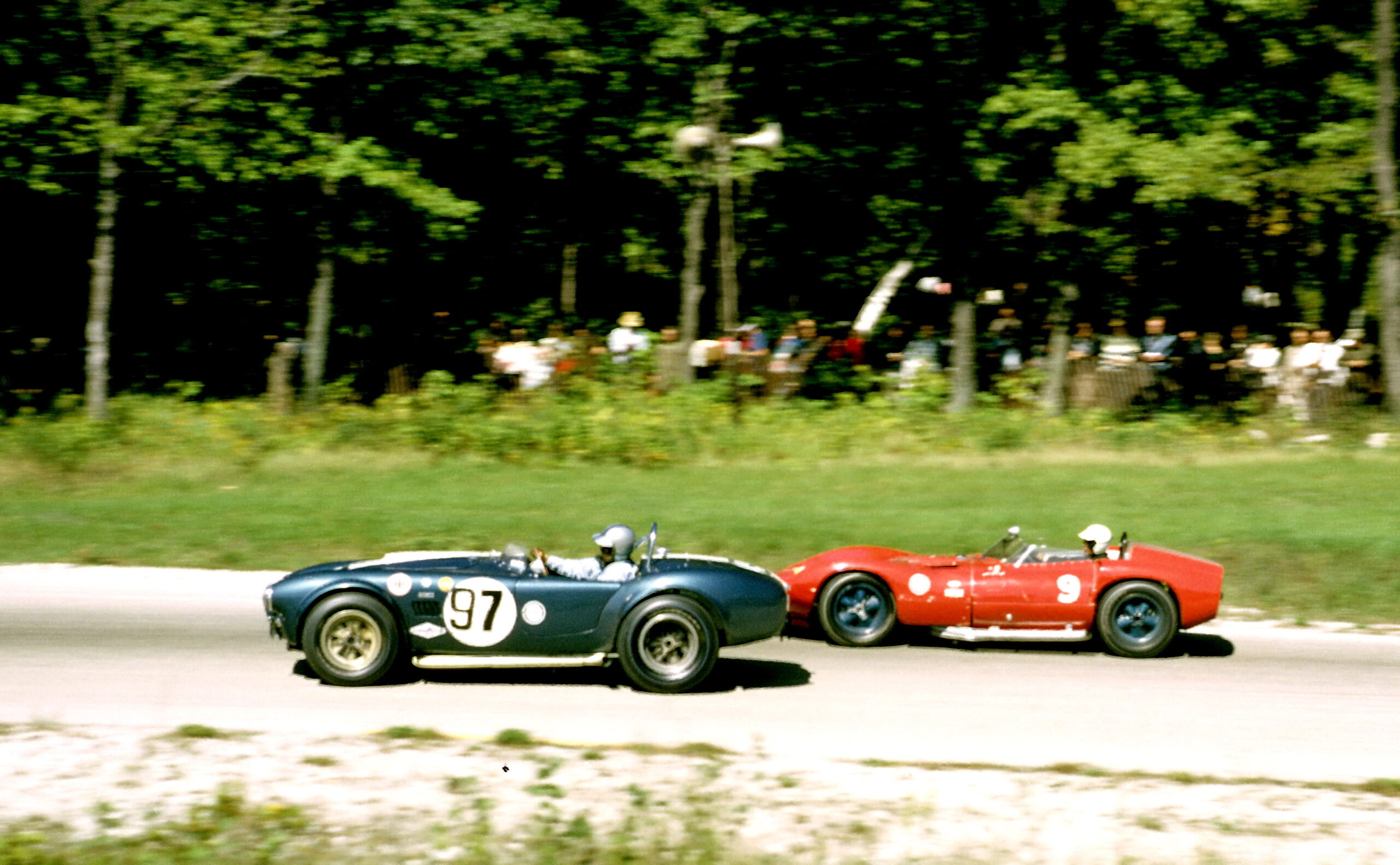
Morton collection – Tom Shultz photo
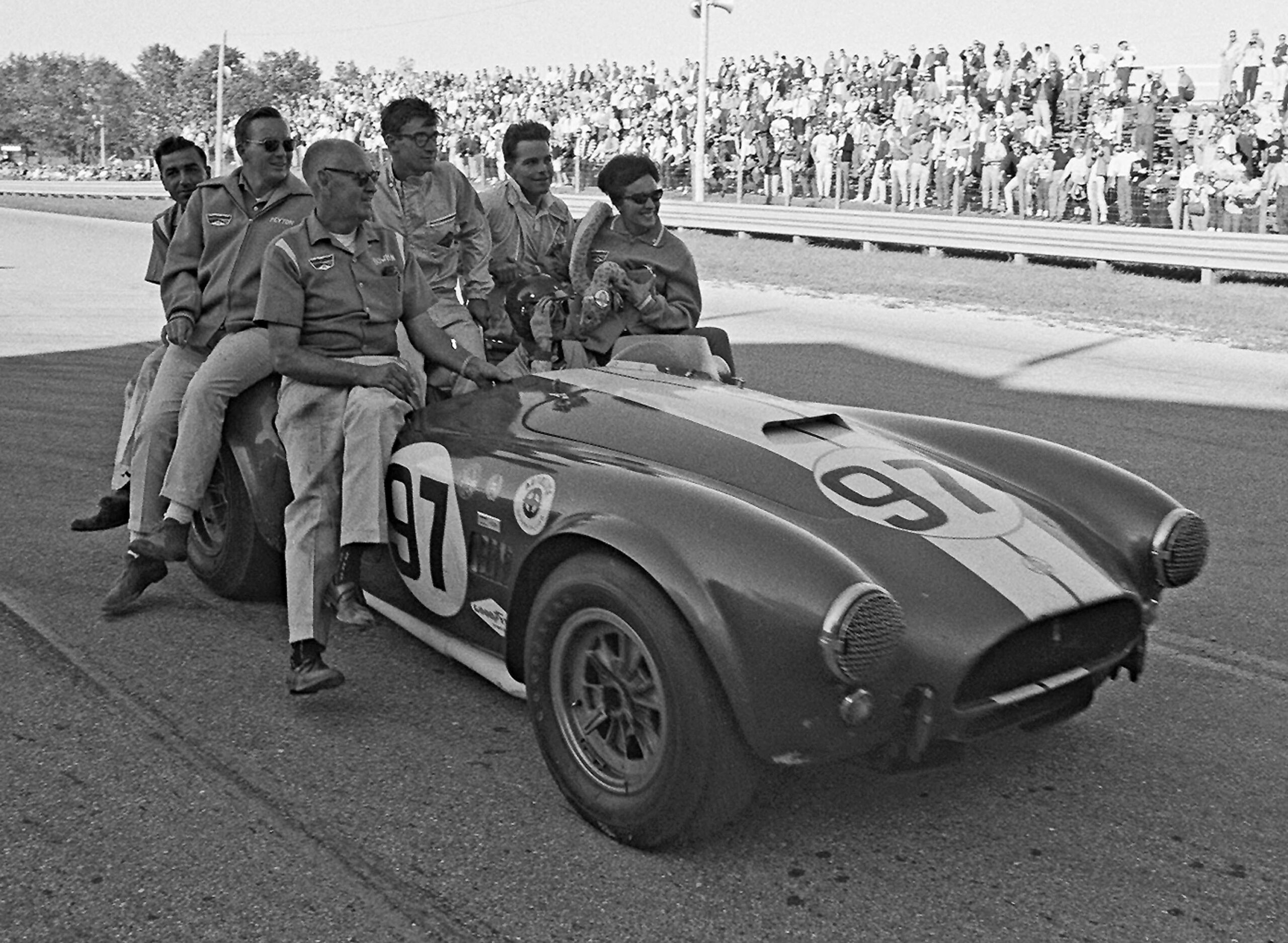
Morton collection – Dave Friedman photo
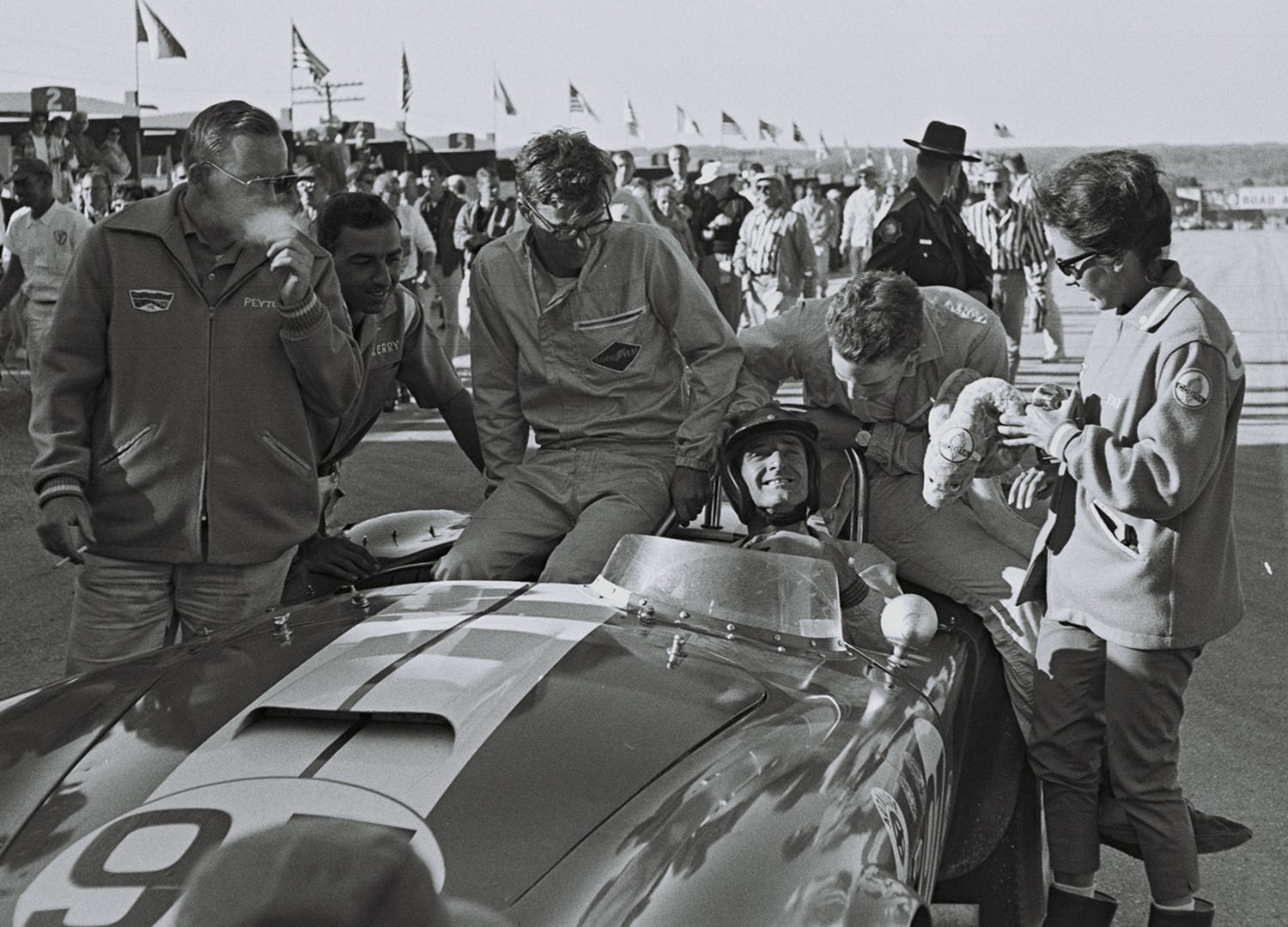
Morton collection – Dave Friedman photo
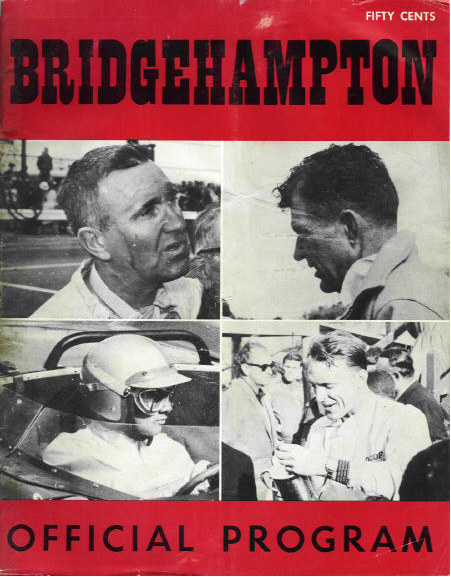
Bridgehampton 500
September 20, 1964
289 Cobra #CSX2558
6th in GT; 11th overall
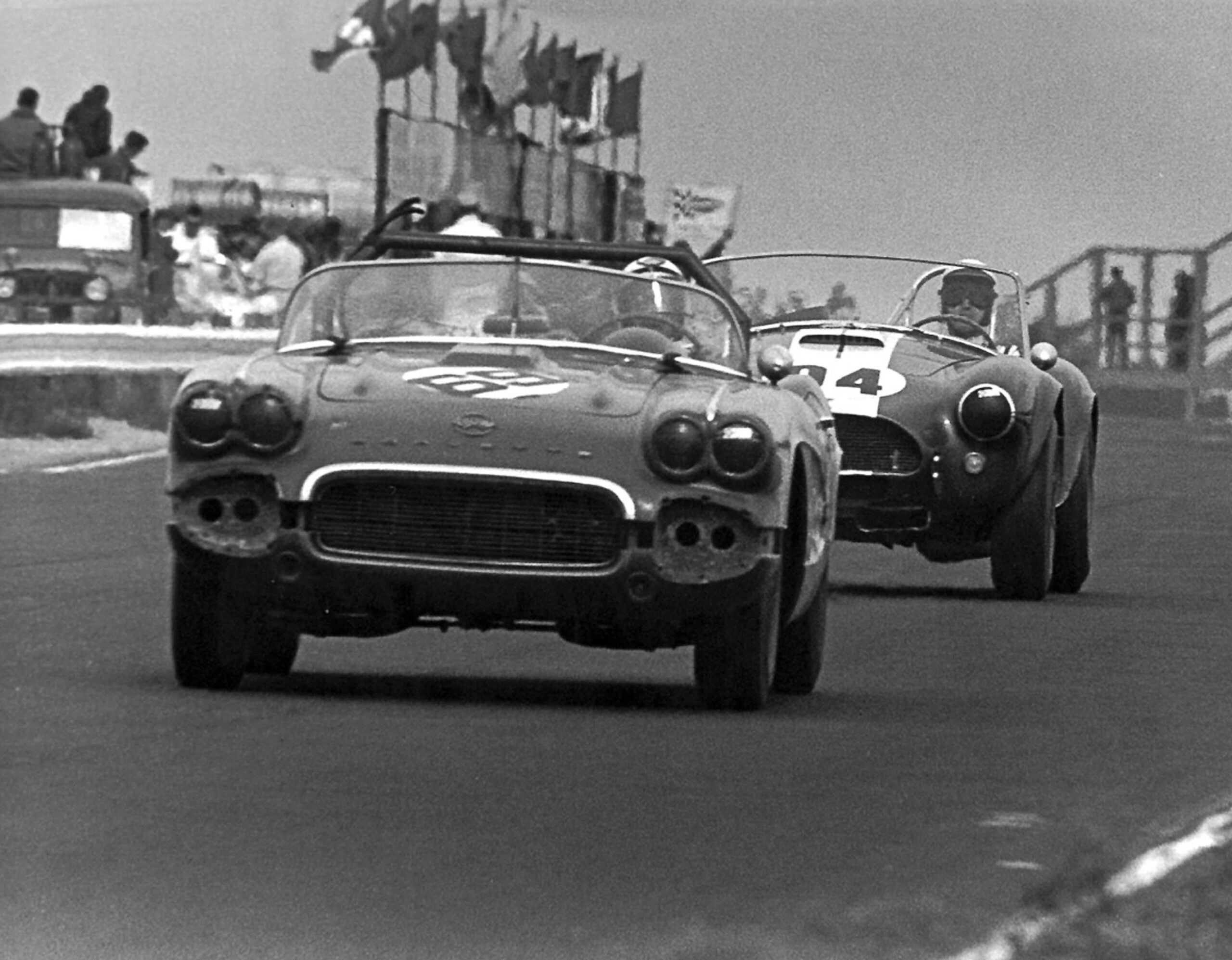
Frank Dominianni’s Corvette leads John’s Cobra – Barcboys photo
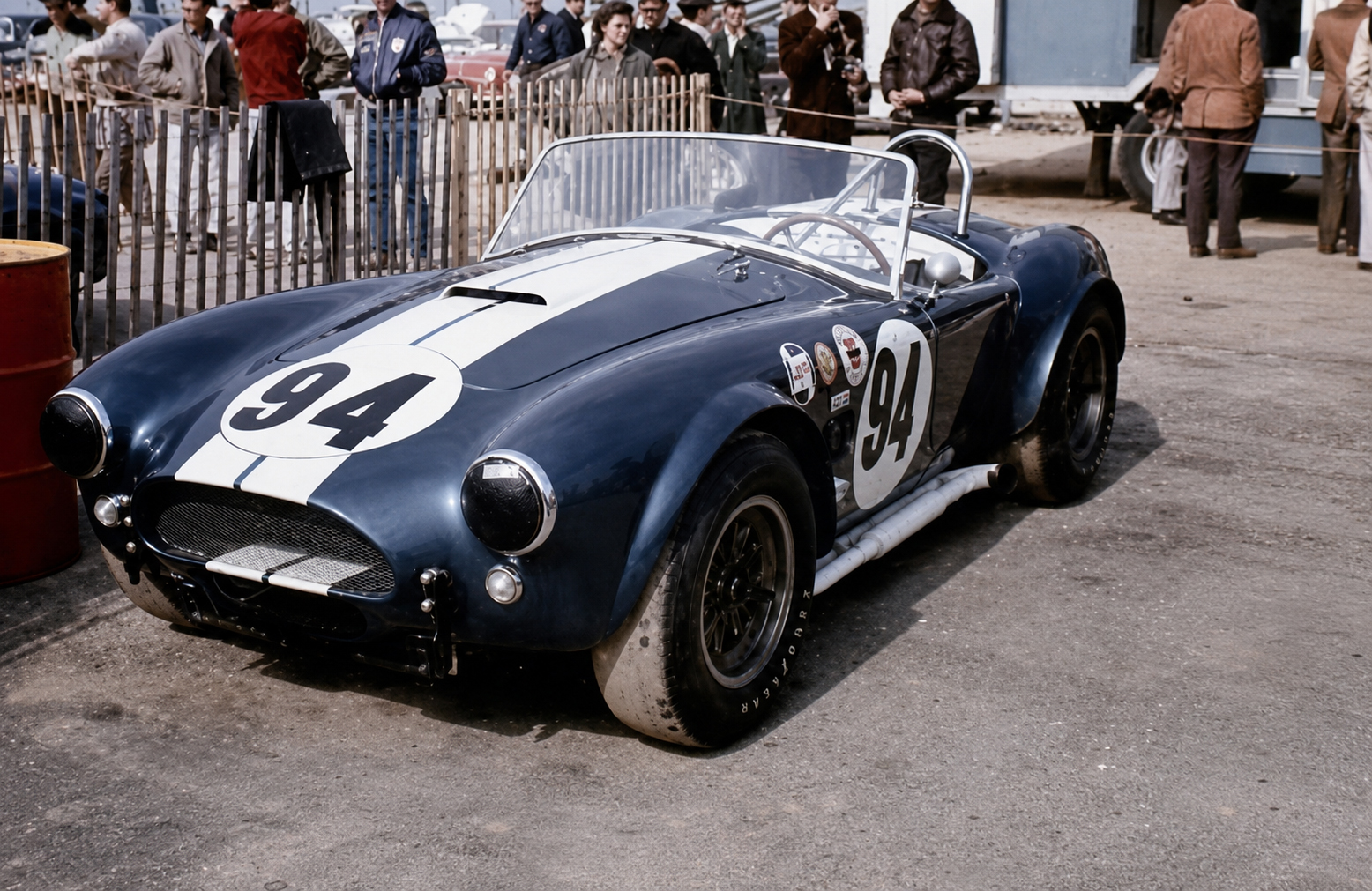
Morton collection – Joe Frietas/Jim Gessner photo
“The Double 500 was the last race of the FIA season for the Shelby team. Al Dowd gave Joe Frietas and me the news that we would share the new number 94.
Bridgehampton was not a particularly difficult course except for the first turn, which was quite intimidating. At the end of the long start/finish straight there was a bridge that in a Cobra was approached at about a hundred and fifty miles an hour. Beyond the bridge the track seemed to disappear, leaving only blue sky as a reference point until the beginning of a very fast right hand sweeping turn with nothing on the left but soft sand, daring the driver to go just a little faster next time.
The other Shelby American drivers were Ken Miles, Bob Johnson, Ed Leslie, Ronnie Bucknum and Charlie Hayes. We finished sixth in GT and eleventh overall.”
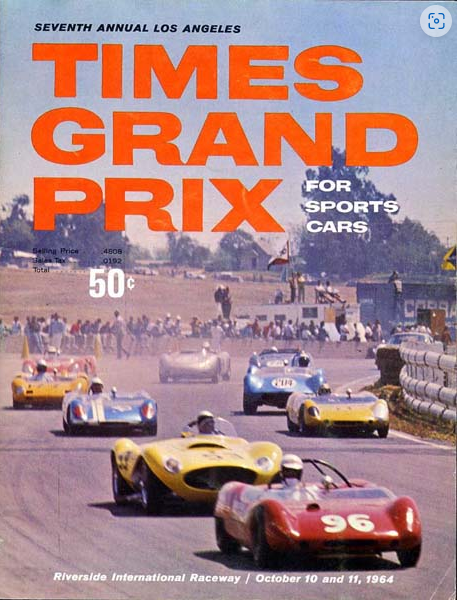
Los Angeles Times Grand Prix
October 11, 1964
Lotus 23B
DNF
Morton collection
Morton collection – Dave Friedman photo
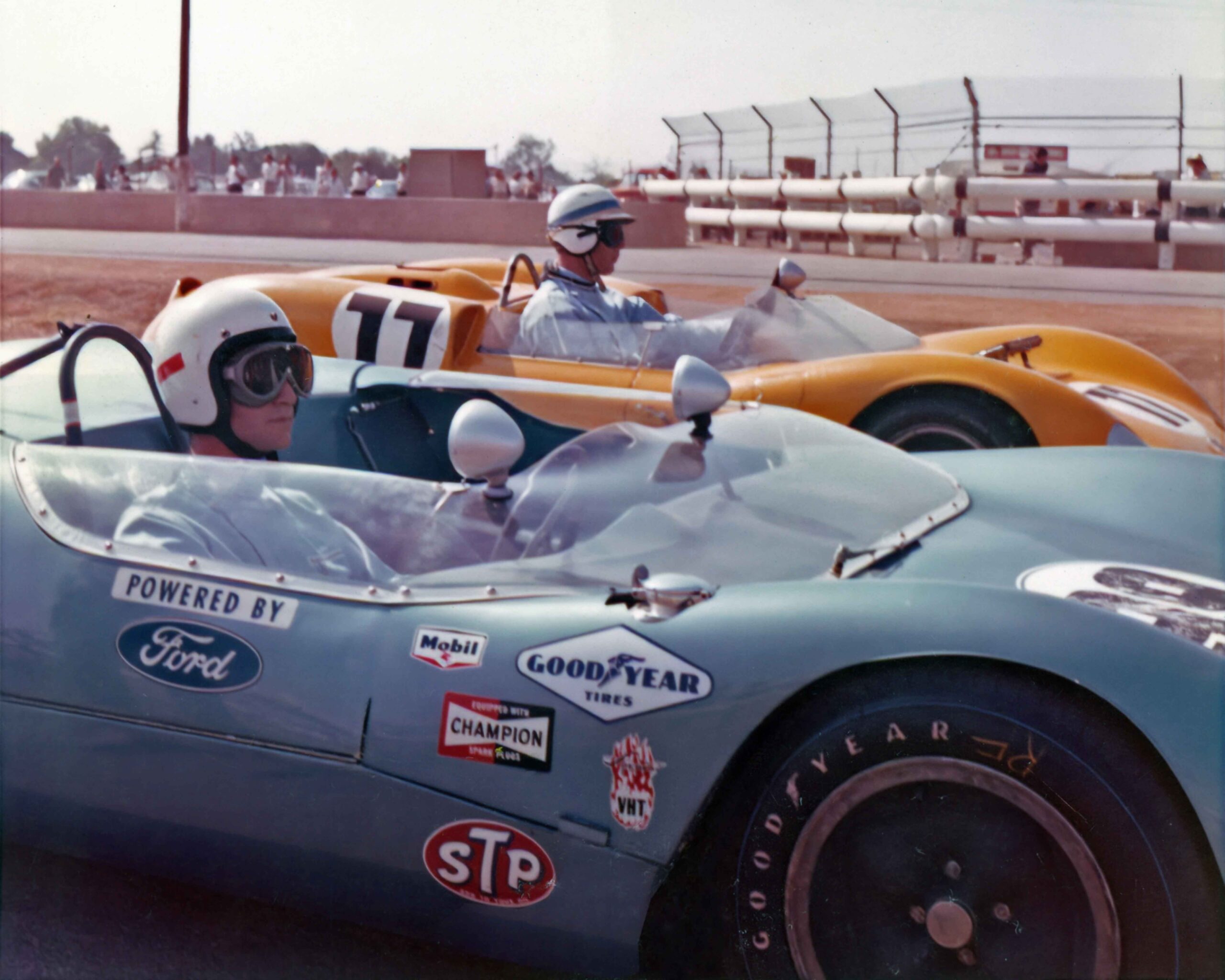
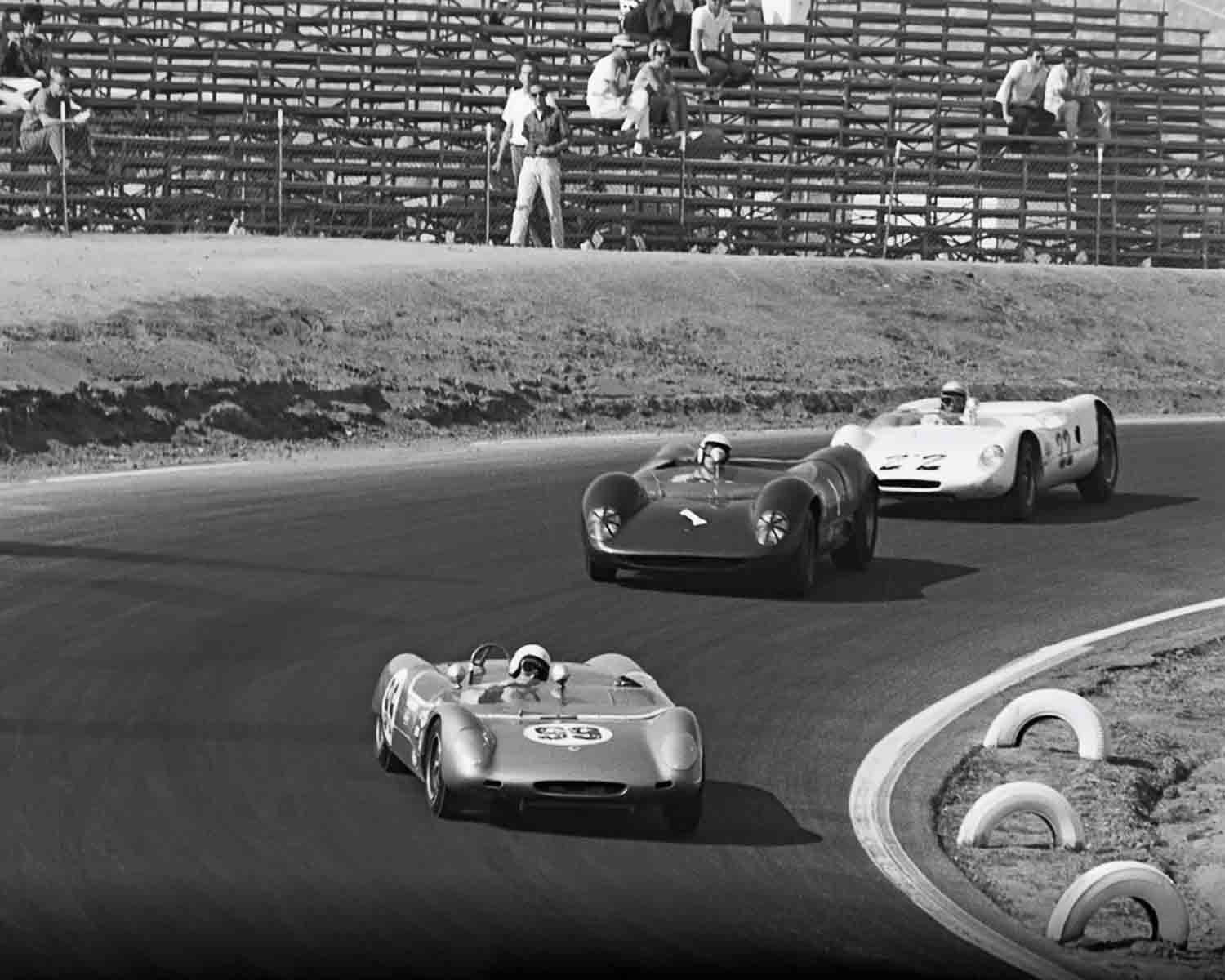
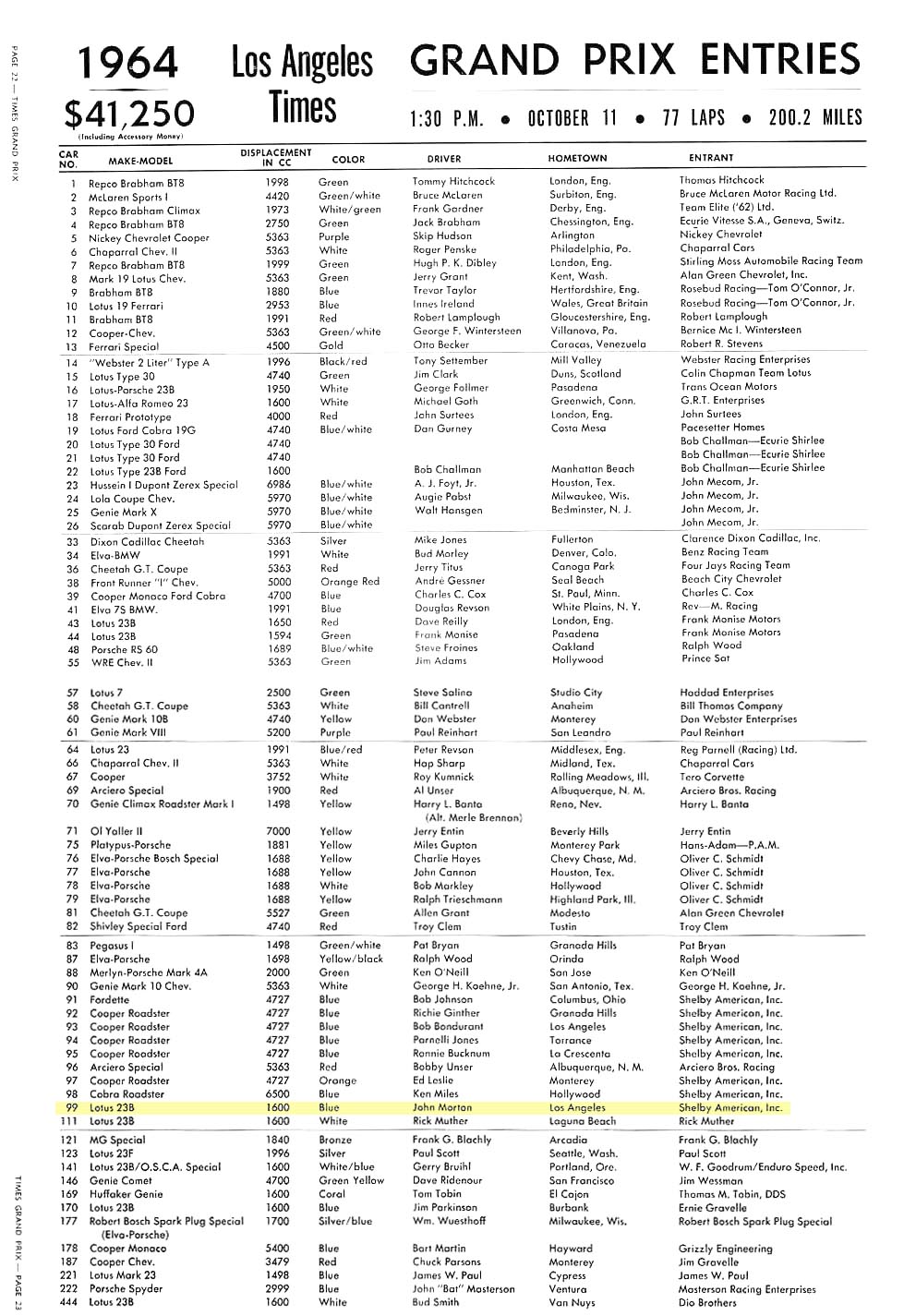
“After qualifying on Friday there were two qualifying races on Saturday, one for under two-liter cars and one for over two-liter cars. The results of these races determined the starting positions for the two hundred mile Times Grand Prix on Sunday. My starting position for the Grand Prix was twenty-fifth. The fastest two-liter car, the Brabham BT8 driven by Hugh P. K. Dibley and entered by Stirling Moss, had the eighteenth starting spot.
To my great amazement, Parnelli Jones was the fastest King Cobra driver and third fastest of all behind Dan Gurney in his Lotus 19B Ford and Bruce McLaren in the first of a very long and successful line of race cars carrying his name called McLarens. Based on their results in the qualifying race, McLaren would start from pole with Walt Hansgen second in the Scarab. Jim Clark was third in the uncompetitive Lotus 30, Penske in Jim Hall’s Chaparral was starting fourth with Parnelli fifth. Parnelli spun in the qualifying race, losing positions but still was the highest Shelby American driver with Ginther seventh and Bucknum eighth.
Bob Bondurant had a small accident in the qualifying race and had to start in the back with Gurney who had a mechanical problem. Frank Lance, Bondurant’s crew chief, explained that Hap Sharp in the second Chaparral, while waiting for the green flag to start the race, held the gas and brake at the same time trying to get a jump with the car’s automatic transmission. The flag was delayed and the overheated transmission started spewing fluid. The race started but coming around at the end of the first lap, Bob hit the transmission fluid and spun, ending his chance for a good starting spot in the Grand Prix.
Early in the Grand Prix, my generator seized when the generator field came apart and it’s wires wrapped around the armature, which in turn stopped the water pump and stopped my race. As a small consolation, I got to see the rest of the Grand Prix as a spectator.”
Monterey Grand Prix
October 18, 1964
Lotus 23B
DNF
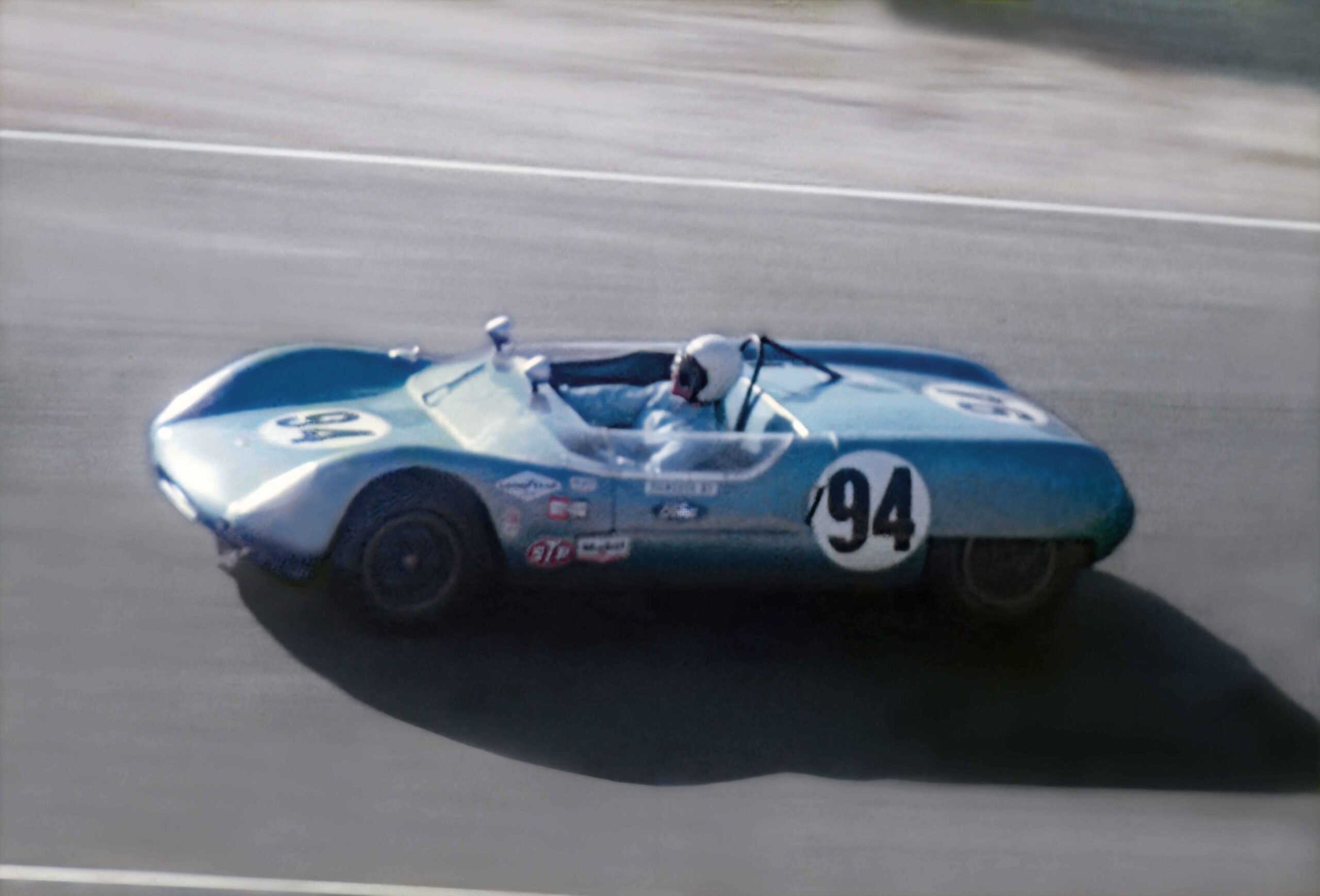
Morton collection
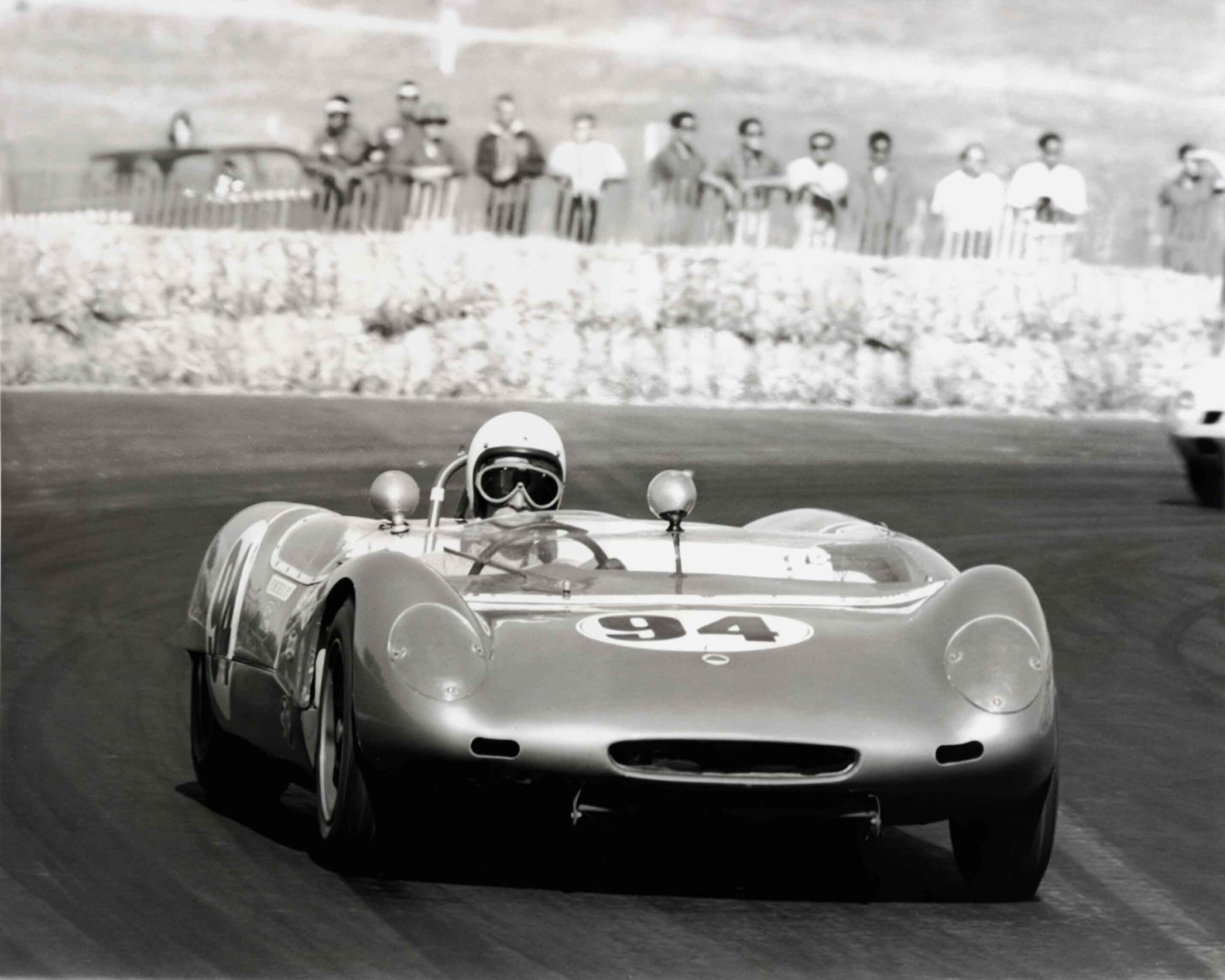
Morton collection – Dave Friedman photo
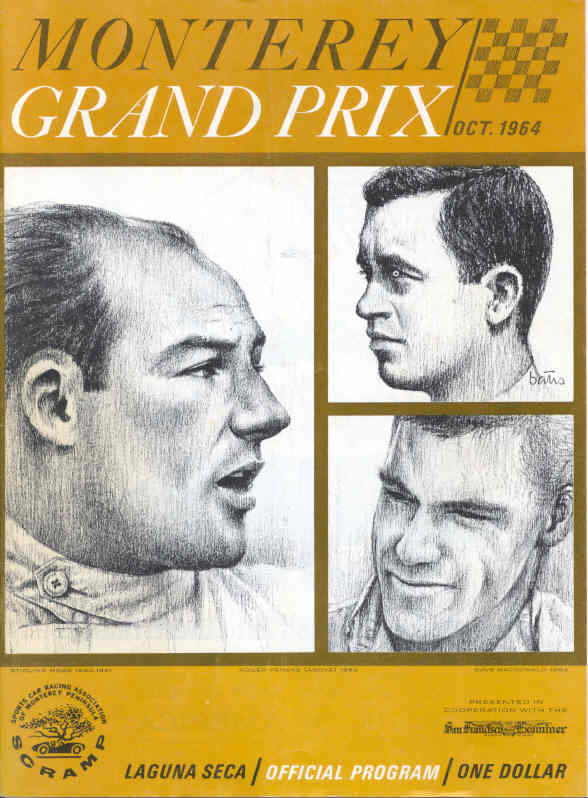
“I wasn’t able to find enough speed to make the race so had to run the consolation with several other under two-liter cars and a few over two-liter cars. I don’t remember how many cars from the consolation race would transfer to the Grand Prix. I do remember that I was trying very hard when I overshot the braking point into the corkscrew turn, skidded across the track and planted myself deeply into the hay bales that lined the outside of the left hand turn. I destroyed the nose of my car, ending my race and my season on a very low note.”
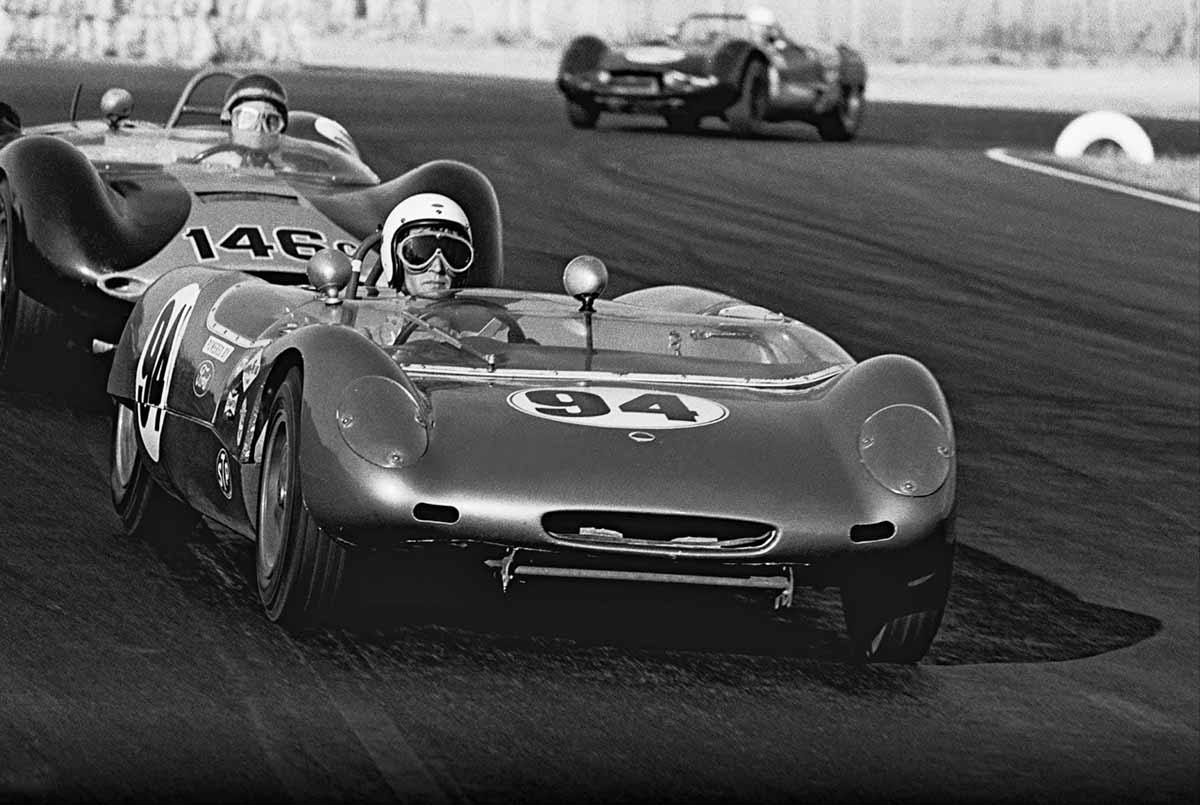
Morton collection – Dave Friedman photo
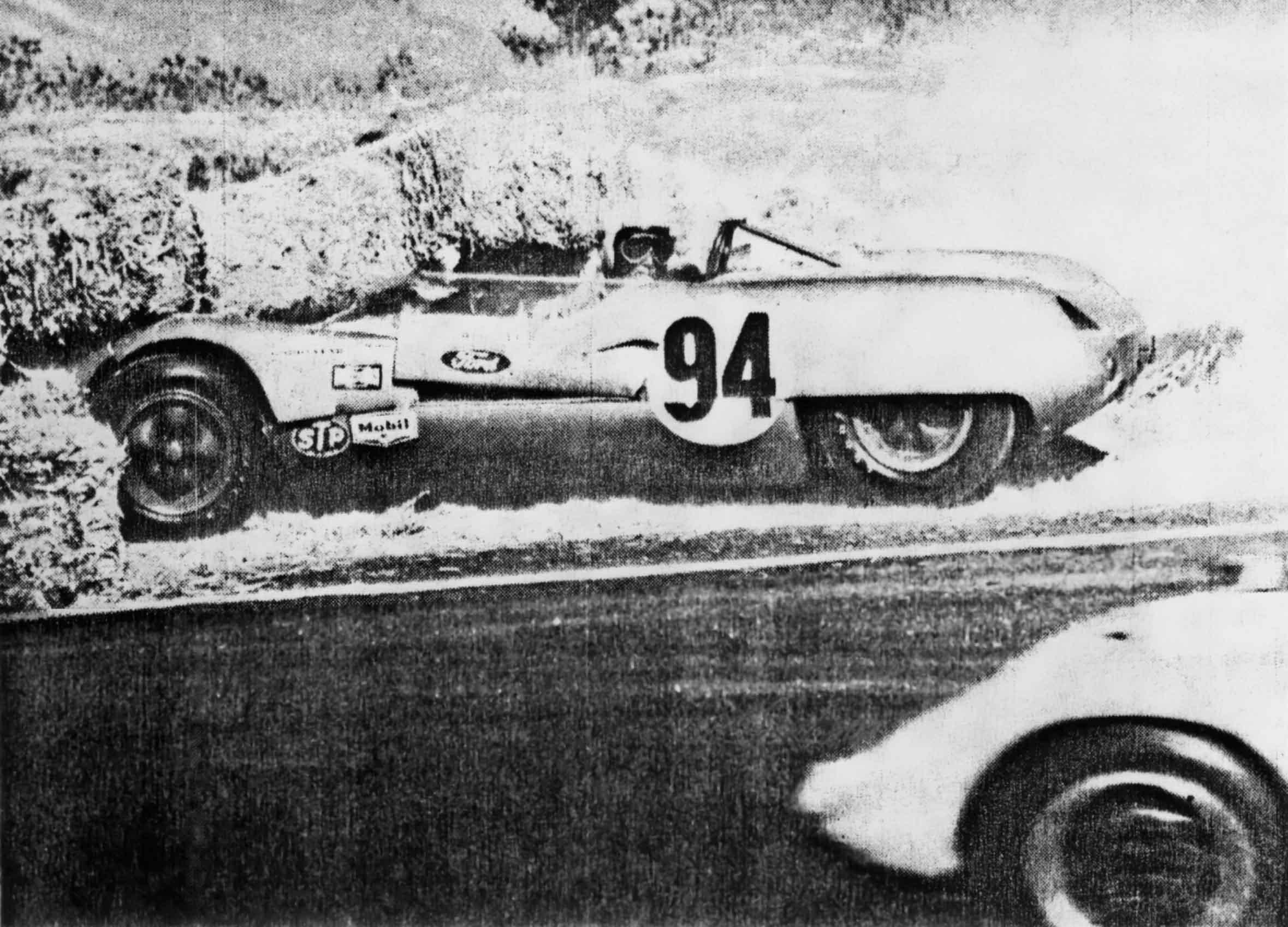
Morton collection
Miscellaneous photos from 1964
Morton collection – Dave Friedman photo
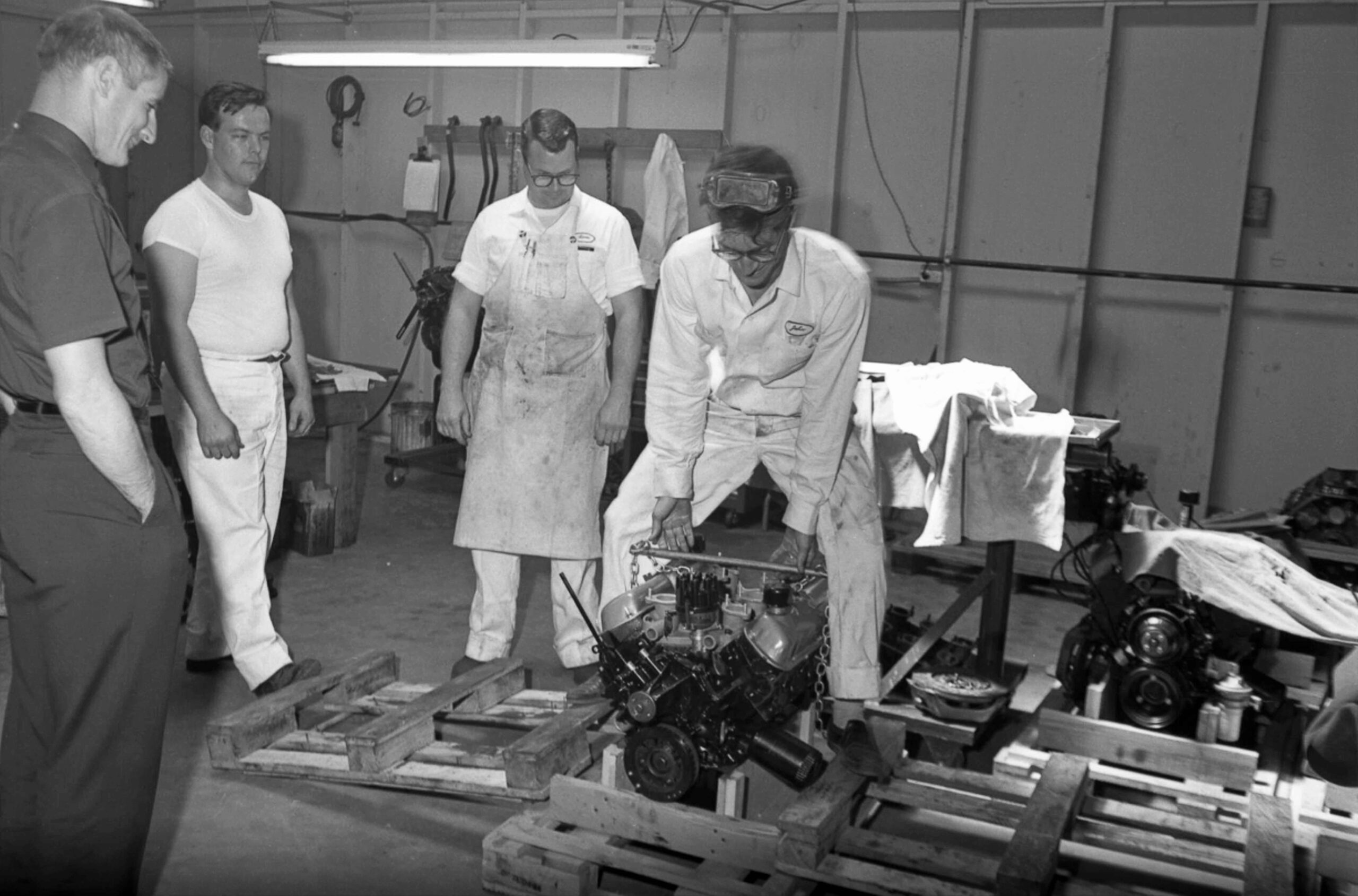
Ken Miles, Ralph Falconer and Shelby American employee watch John attempt to lift an engine. Ralph eventually completed the lifting job.
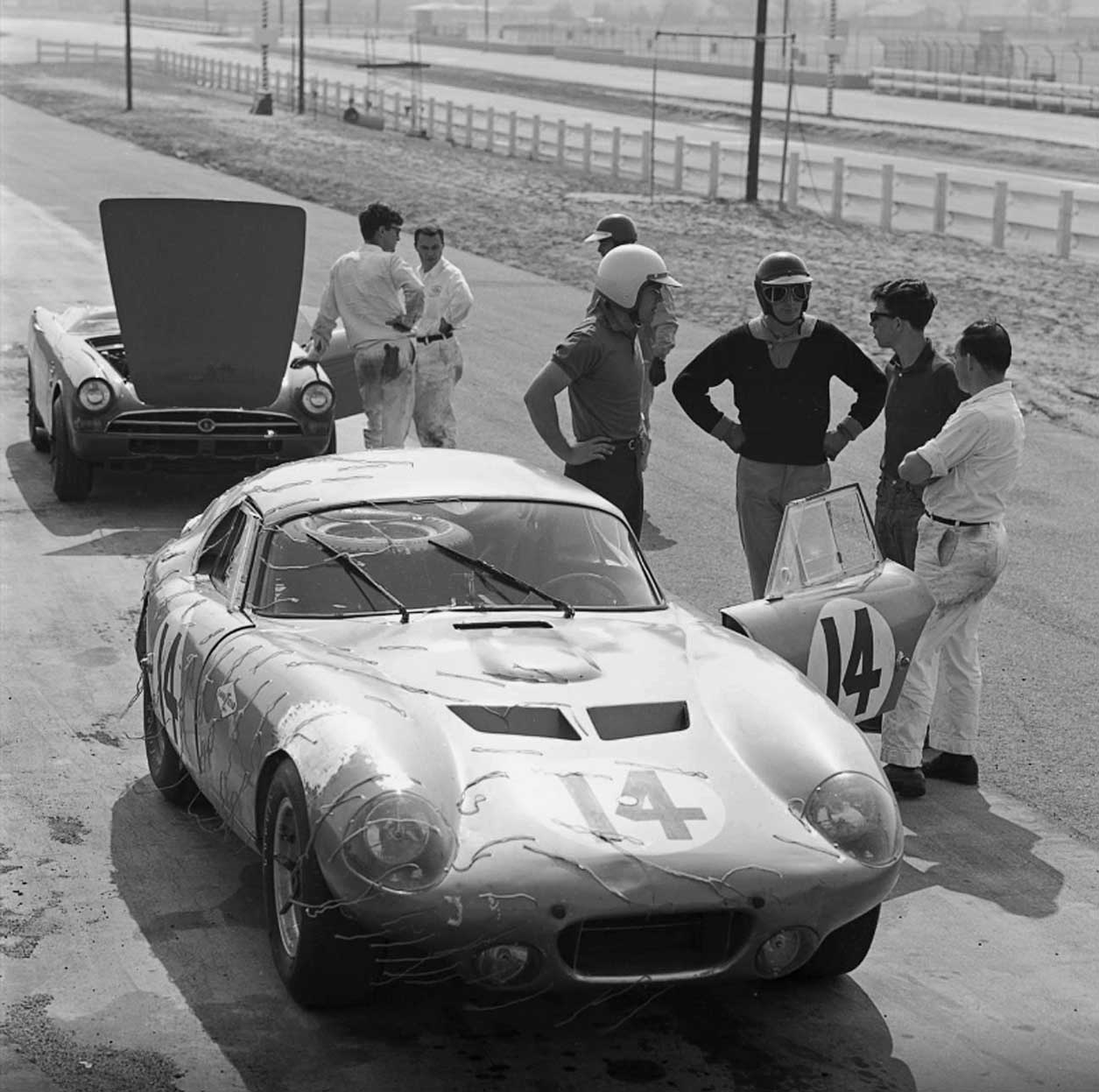
“The Sunbeam Tiger and the Cobra Coupe were taken to Riverside; the Tiger for its maiden voyage and evaluation by Lew Spencer, the Coupe to try to get a better idea of the airflow patterns over the body. Pieces of yarn about four to five inches long were taped to the body every few inches. As the car was driven, the yarn would indicate what the air was doing as it flowed over the bodywork. Pete Brock was there to study the flow patterns, hoping to gain more information about his creation. One of the priorities was to learn how to get airflow through the cockpit for the overheated drivers.
Ken Miles drove the Coupe. Charlie Agapiou and John Collins made sure everything ran smoothly. Ken gave me a ride in the Coupe after the testing was over. It was a real eye opener. I’d never been in an enclosed racecar before. It sounded and felt like being trapped inside of a giant drum. I couldn’t believe how he got that thing through the Riverside esses so fast. It’s a common belief that in a racecar, the passenger’s seat travels about twenty miles per hour faster than the driver’s seat. It was a thrill.”
Morton collection – Dave Friedman photo
Morton collection – Dave Friedman photo
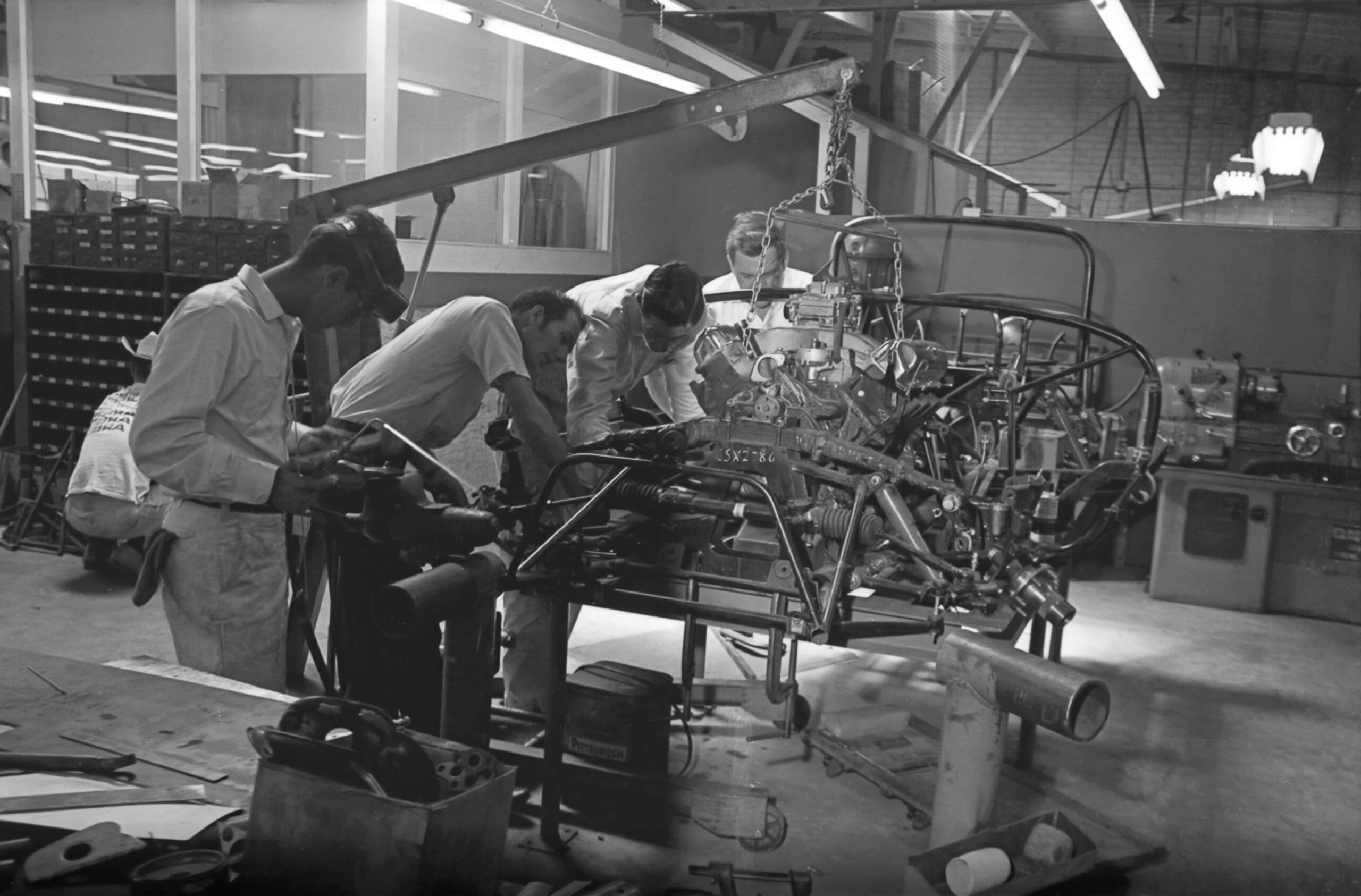
The last Cobra Coupe chassis being prepared to accept a 427 engine. John is shown welding; Lynn Brewer, Bill Eaton and another mechanic work on installing the engine. The car never ran in the 427 configuration.
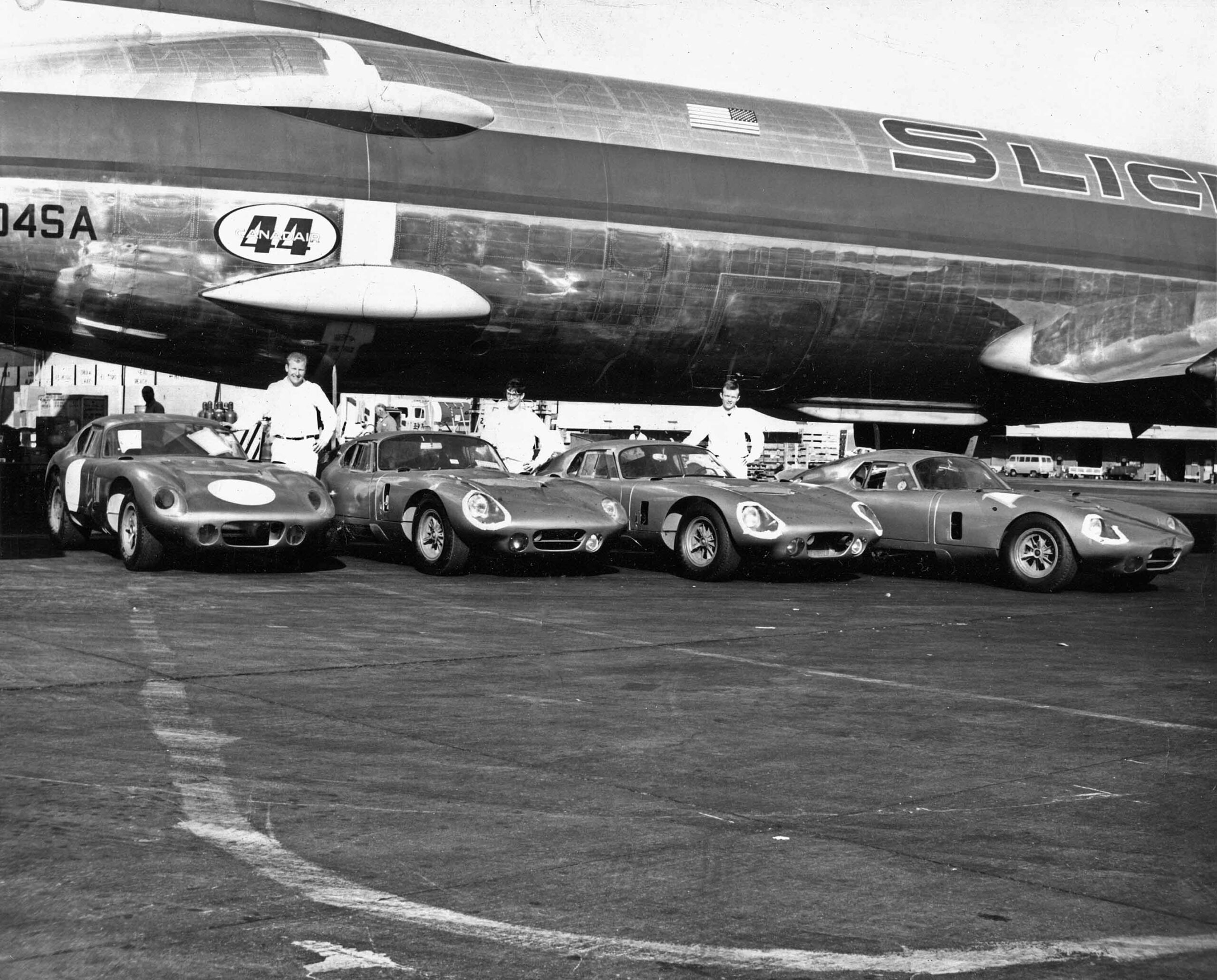
Allen Grant, John and Earl Jones stand next to Cobra Coupes that had just cleared customs at LAX. The coupe on the right had been stretched to accommodate a 427 engine, but never ran in the configuration shown.
Morton collection – Dave Friedman photo